Steve Jobs once gave a piece of advice that feels even more relevant today:
“You’ve got to start with the customer experience first and then work backwards to the technology.”
That principle matters enormously in the age of AI.
The temptation now is to begin with the technology. We ask: What can AI do? Where can we apply it? What market can we sell it into?
Jobs’ logic runs in the opposite direction.
Start with the problem.
Define the experience.
Design the process.
Then choose the technology that supports it.
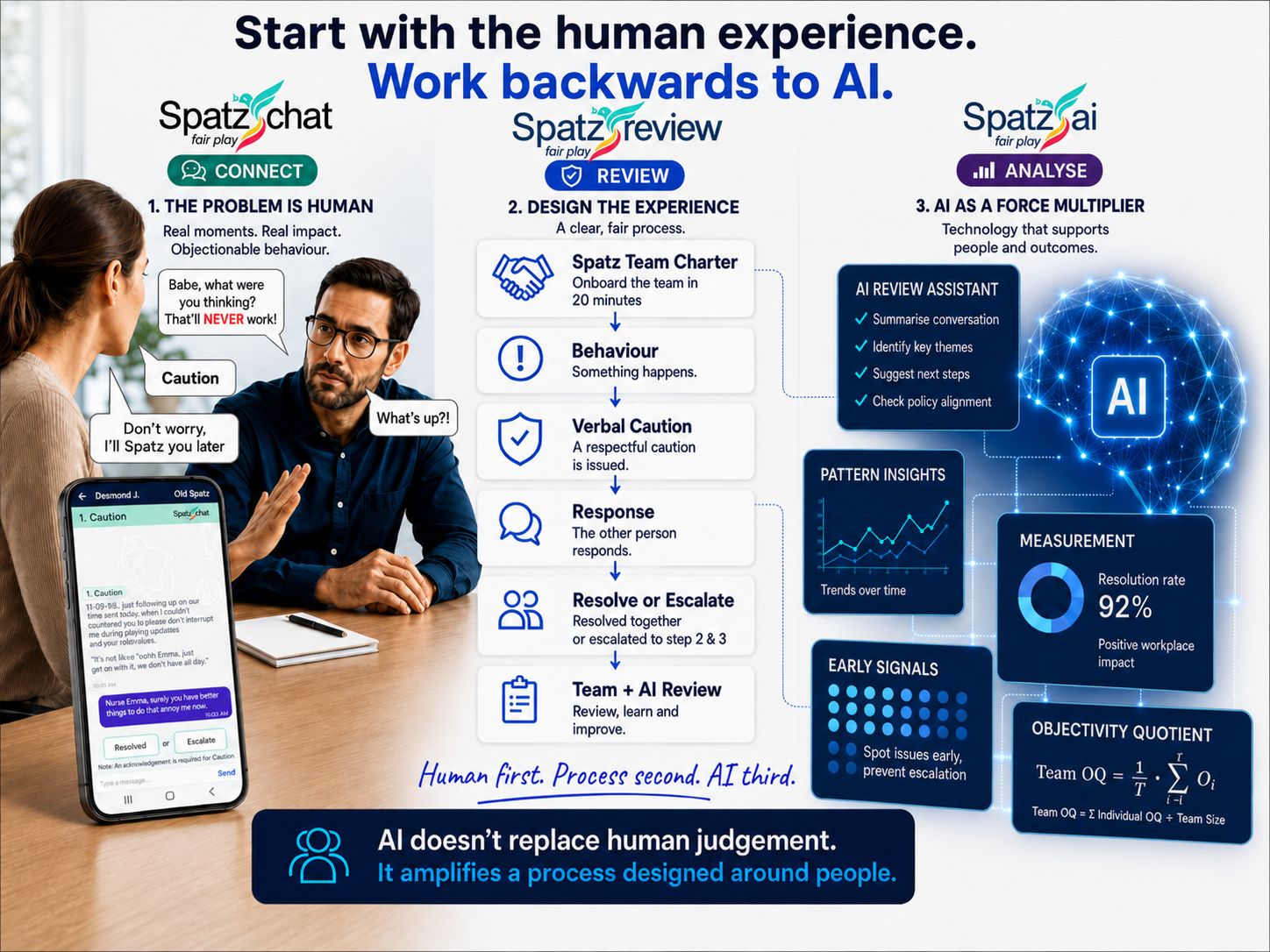
That is essentially how Spatz developed.
The problem came first:
What happens when everyday workplace behaviour becomes objectionable, but the issue is still too small or too early for a formal grievance or conventional HR process?
The desired experience was also clear: people should have a simple, fair and immediate way to address the behaviour themselves.
That led to the process:
Behaviour → Caution → Response → Resolve or Escalate → Review.
Only then did AI become important.
AI can assist with review, summarisation, pattern detection, measurement and, eventually, prediction. But AI is not the premise of Spatz. The human behavioural process is.
That distinction matters.
As AI improves dramatically, Spatz benefits. If today’s AI technology changes completely, the underlying workplace problem still exists and the process still has value.
So I think Jobs’ advice can be updated for today:
Start with the human experience and work backwards to AI.
Don’t start with AI and work forwards looking for somewhere to use it.
Spatz was not an AI idea looking for a problem.
It was a behavioural problem that was waiting for technology and eventually found a smart app, AI and a review platform.
That, to me, is the much stronger starting point.


Leave a comment