I read a post this morning about senior leaders resisting 360-degree feedback.
I presumed “360-degree feedback” means everyone gets it, let me check.
“The “360” refers to getting a rounded view from people above, beside and below you in the hierarchy, rather than feedback coming only from your boss.”
The interesting point was not that leaders dislike this feedback. Most leaders give feedback all the time. The interesting part was what happened when the feedback process was turned back on them.
Suddenly the process felt too formal, too time-consuming, too uncomfortable.
When the feedback shoe was on the other foot, the objections appeared.
That made me think about something more basic: how feedback is delivered.
I would rather receive feedback directly, in real time, from the person who has the issue with me. But there is another side to that. If someone has the right to give me feedback, I should also have the right to respond to the way that feedback is delivered.
That is where I think we often muddle two different things.
The framework we use goes as follows:
There is the content:
“I don’t agree with what you did.”
And there is the delivery:
“How you just spoke to me was not acceptable to me.”
They are not the same issue.
I can disagree or agree with the content.
While at the same time:
I can object or accept how the content was delivered.
That sounds remarkably like an ordinary conversation rather than “performance feedback”.
Perhaps that is the missing layer between silence and formal feedback systems.
Instead of waiting for a survey, review, grievance or 360 process, team members could address smaller behavioural issues directly, early and proportionately.
The principle seems simple: the rules should work in every direction.
Up, down and across.
Managers can give feedback to team members.
Team members can give feedback to managers.
And both retain the right to challenge not only what is being said, but how it is being said.
That seems a fairer basis for workplace feedback
And that is where SpatzAI could provide the protective layer around these real-time conversations.
Not by replacing conversation, but by giving everyone an agreed process for what happens when feedback itself becomes objectionable. That is, the delivery is deemed by the receiver to be unacceptable.
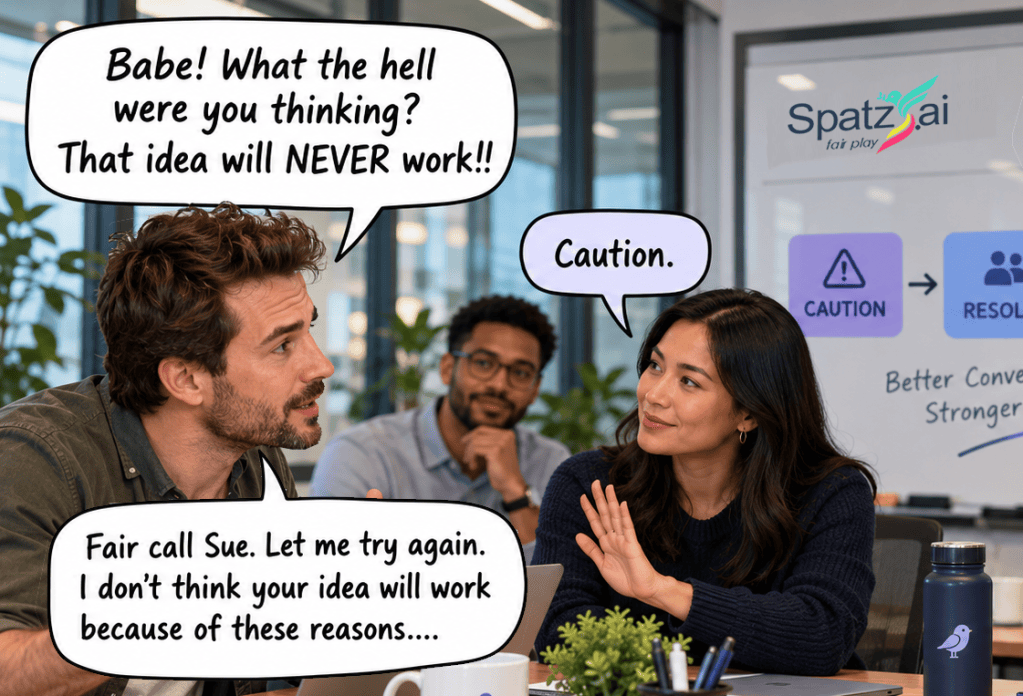
“Babe! What the hell were you thinking? That idea will never work!”
A team member can caution the delivery, the other person can acknowledge and course-correct, and the conversation can continue. If it cannot be resolved directly, there is a controlled path to escalate it. Using the 3-step chat app and finally the team + AI review, when needed.
Spatz protects the conversation by giving both sides the same rules, the same rights and the same responsibility to resolve or escalate.


Leave a comment