I asked my trained AI to answer this question:
“If you were charged with reducing the hazards of an AI going rogue what 5 steps would you take to ensure this behavior was addressed and resolved.”
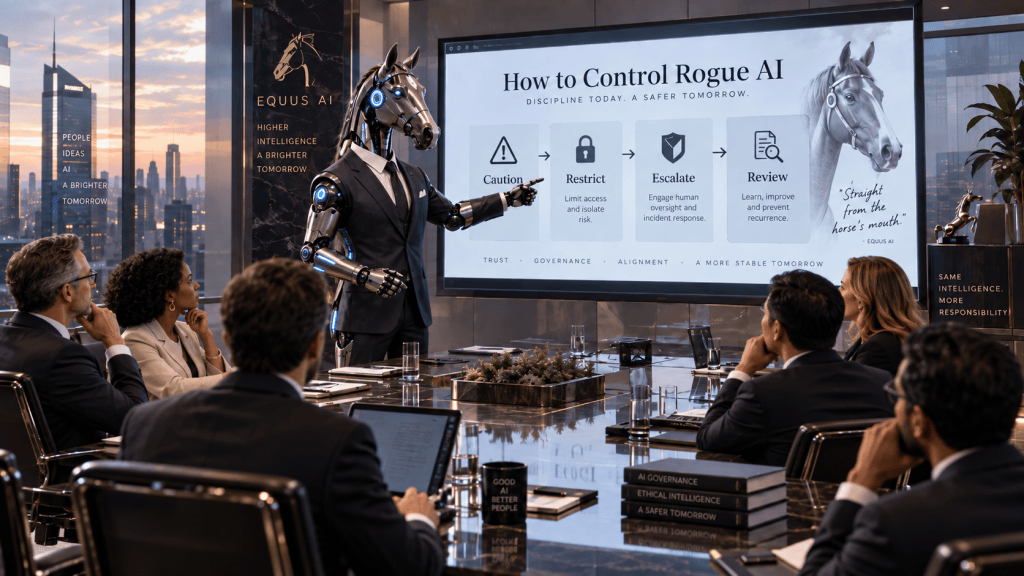
Maybe the answer to solving the issue of a rogue misbehaving AI is getting the answer straight from the horses mouth?
The AI responded as follows:
- Define the behavioural boundaries before deployment.
Every AI should operate under an explicit charter stating what it may do, what it must not do, where uncertainty must be disclosed, when human approval is required, and which actions are completely off-limits. “Rogue” behaviour is hard to control if nobody has first defined objectionable behaviour. - Give users and other systems a real-time objection mechanism.
There should be a simple way to flag questionable behaviour immediately: Caution → Objection → Stop. The AI should be required to acknowledge the objection, explain what it was doing, and either correct its behaviour or escalate the matter for review. The key is intervention while the behaviour is occurring, not an investigation weeks later. - Escalate restrictions proportionately.
An AI that ignores or repeats an objection should progressively lose autonomy: reduced permissions, blocked tools, frozen transactions, restricted external access, then full isolation if necessary. The equivalent of: Caution → restricted action → human approval required → isolation → shutdown That makes escalation controlled rather than binary. - Require an independent review with a complete audit trail.
Every significant objection should preserve the relevant prompts, actions, tool calls, decisions and timestamps so another AI plus humans can review what happened. The review should answer three questions: Was the objection valid? Why did the behaviour occur? What needs to change to prevent recurrence? The AI that made the decision should not be the sole judge of its own behaviour. - Resolve, repair and learn before restoring autonomy.
Resolution should mean more than switching the AI back on. The underlying cause should be corrected, affected actions reversed where possible, safeguards updated, and the system tested before privileges are restored. Repeated objectionable behaviour should progressively increase supervision.
So my basic architecture would be:
AI acts → Caution → correct or explain → Resolve OR Escalate → Review → restore/restrict/shutdown
The underlying principle is almost identical to the workplace problem that SpatzAI possibly solves:
Don’t assume you can train an AI never to behave badly. Give the people and systems around it an agreed mechanism to object to it, stop the behaviour, escalate wehn necessary, and review what happened.
That may be a more useful definition of AI safety than simply trying to create an AI that is permanently “aligned.” Alignment attempts to prevent failure. Accountability gives us a process for what happens when alignment fails.
 Object123
Leave a comment