Most workplace systems still treat objectionable behaviour as something for leadership or HR to decide.
That makes sense once a matter has become serious.
But what about the moment before that?
What about the small public put-down, the dismissive tone, the repeated interruption, the sarcastic remark, the patronising comment, or the unfair delivery during disagreement?
And most importantly of all, what if this behavior came from the leadership itself?
At that early stage, the team member often already sensed the unease.
The problem is that not having an agreed way to call it out, pause it, and resolve it fairly.
So the decision is usually pushed onward and upward:
Is this a management issue?
Is this an HR issue?
How many times has it happened?
Was it serious enough to report?
SpatzChat starts from a different assumption.
Before behaviour becomes an HR matter, it is often first a team matter.
That does not mean mob rule.
It does not mean blame.
It does not mean public punishment.
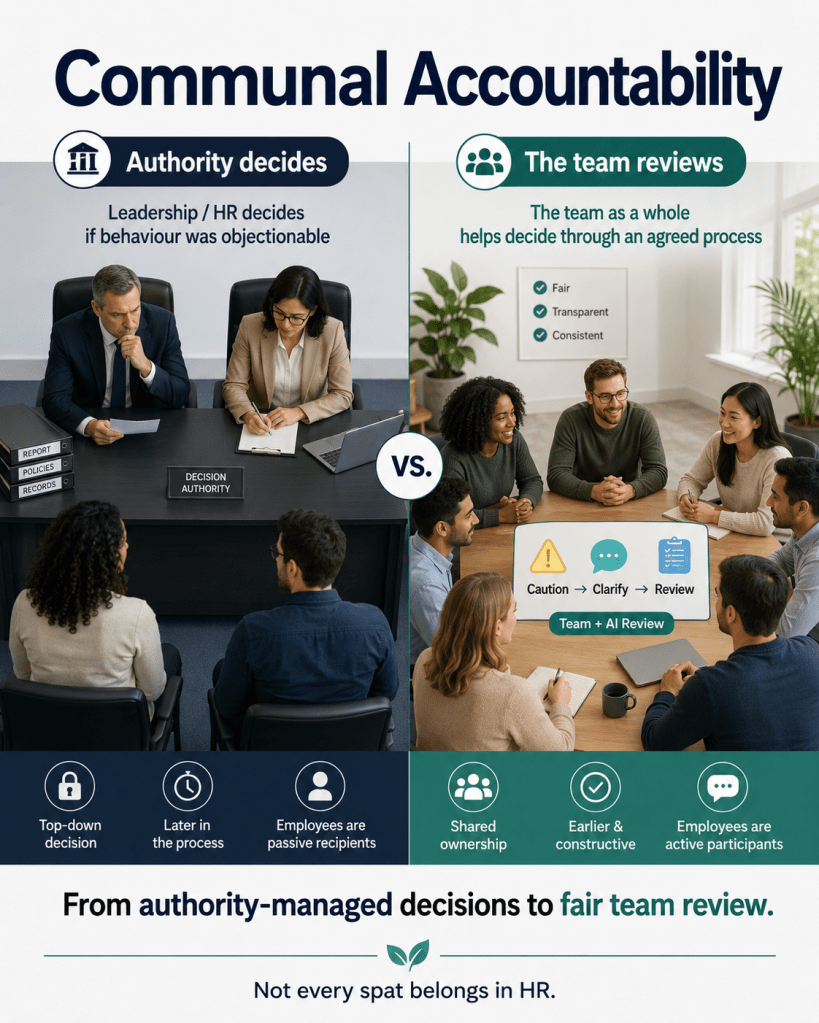
It means communal accountability through an agreed process.
Any team member can issue a caution.
The other person can acknowledge, clarify, apologise, or object.
If unresolved, the matter can go to Team + AI Review.
The key difference is this:
Leadership does not decide alone whether behaviour was objectionable.
HR does not decide alone whether behaviour was objectionable.
The team, using an agreed fair-play process, initially helps decide whether the caution was justified.
That is the shift.
From authority-managed accountability
to communal accountability.
Not every spat belongs in HR or with managers.
Some spats simply need a fair team process before they become something bigger.


Leave a comment