If you’ve ever been put on a Performance Improvement Plan (PIP), you might have felt the ground shift under you. Suddenly, your value is in question, your targets are unclear, and your future feels pre-written. A recent viral post by employment lawyer Katherine Kleyman lays bare what many already suspect: PIPs are often not about helping employees improve, but about laying the groundwork for dismissal.
So where does that leave the employee? Right now, most are left scrambling to defend themselves alone, but that’s where SpatzAI comes in.
SpatzAI provides a real-time, peer-supported way to caution, object, and escalate concerns fairly. Below, I break down exactly how someone facing a PIP can use the Spatz model to push back on unfair treatment and bring transparency into a process often shrouded in silence and HR jargon.
Using SpatzAI’s structured Caution–Objection–Stop–Review model, an employee on a PIP (Performance Improvement Plan) can transform a potentially demoralizing and pre-determined process into a documented, peer-visible accountability trail. Here’s how they could approach the scenario outlined in Katherine Kleyman’s post:
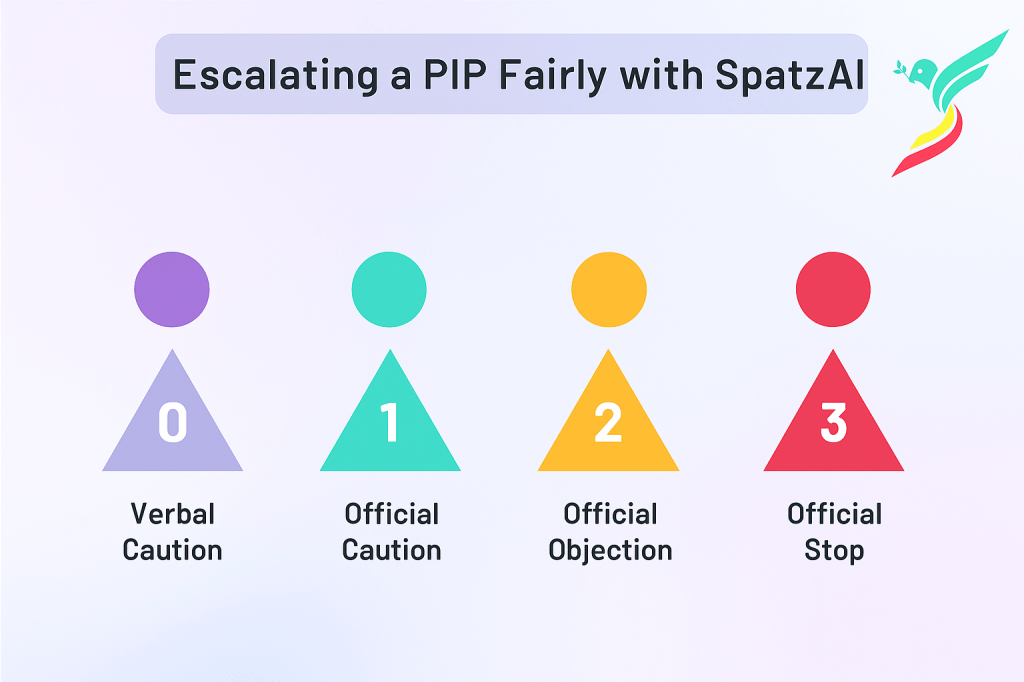
⚪ 0. Verbal Caution (Informal pause)
Trigger: The employee notices a shift—e.g., unrealistic targets or vague criticisms, excessive dogma, and righteous indignation from above.
Action:
“I’d like to give a verbal caution that the expectations set in the PIP feel misaligned with what was discussed before. I’d appreciate clarification to ensure I’m working toward something achievable.”
This triggers awareness in the manager and flags the moment before it escalates.
🟢 1. Formal Caution (Documented in the Spatz Chat App)
Trigger: The manager moves the goalposts, ignores positive feedback, or gives inconsistent directions.
Action:
“I’m issuing an official caution that the new expectations outlined in our latest meeting were not part of the original PIP, and I feel they’re shifting the benchmark. This feels unfair and sets me up for failure.”
This records the concern and gives the manager a chance to acknowledge it.
🟡 2. Formal Objection (Documented in the Spatz Chat App)
Trigger: More fabricated “concerns” are added, or previous improvements are dismissed.
Action:
“I object to the introduction of new concerns that weren’t in the original PIP. Despite documented improvements and feedback from colleagues, I believe I’m being held to a subjective and moving standard. I’d like this reviewed.”
This requests a simple apology or acknowledgment of unfair expectations.
🔴 3. Formal Stop (Automatically Posted onto the Team and AI Review Platform)
Trigger: No resolution, or the employee feels the PIP is being used as a termination tool regardless of performance.
Action:
“I’m issuing a Stop. I believe the PIP is being used as pretext for termination. I’m requesting a team-assisted review via the Spatz Review platform to assess fairness and treatment.”
This activates peer oversight, bypassing traditional authority lines and escalating the concern without escalating hostility.
✅ 4. Spatz Review Outcome
If the review confirms the employee’s claims (e.g., performance improved but disregarded, expectations shifted), the team might:
- Recommend amending the PIP to reflect fair metrics
- Suggest coaching or mediation
- Call out management behavior as a micro-psychosocial hazard
Summary:
SpatzAI doesn’t stop a biased PIP system outright, but it gives employees:
- A real-time, documented path to object.
- A process that shifts from managerial dominance to team-supported fairness.
- A psychologically safe way to raise red flags without retaliation.
In a system like the one Katherine described, SpatzAI empowers the employee to confront the imbalance publicly, constructively, and with peer support.
 Object123
Leave a comment