
For decades, many organisations have invested in resilience training, encouraging employees to become better at coping with workplace pressures, difficult conversations and objectionable behaviour.
But I think we may be overlooking a more fundamental question.
Rather than primarily teaching people how to tolerate objectionable behaviour, why aren’t we teaching teams how to object to it?
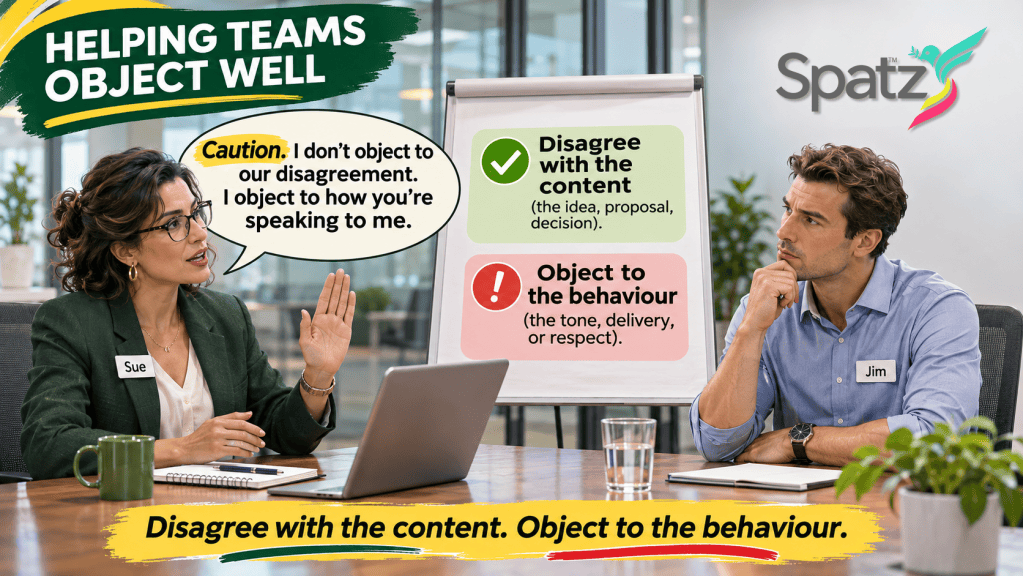
Consider two colleagues, Sue and Jim, having a disagreement.
Jim becomes increasingly dogmatic, talks over Sue, rolls his eyes and dismisses her contribution.
Sue was trained to be resilient. She takes a deep breath, regulates her emotions, reframes the situation and tries not to take it personally.
But what has changed?
Jim’s behaviour remains unaddressed, and Sue carries much of the responsibility for managing its consequences.
What if Sue and Jim and their team had already agreed on a fair, reciprocal process for addressing objectionable behaviour in real time?
Sue could simply say, “Caution.”
Jim could acknowledge her caution, and both could continue their disagreement without unnecessary friction.
If Jim challenged or ignored her caution, Sue could escalate proportionately by inform Jim, “I’ll Spatz you later Jim”, and messaging him at a more convenient time and place, using their bespoke objection SpatzChat app.
If still unresolved Sue could finally escalate to the Team + AI Review process to have their spat independantly examined.
This is the thinking behind SpatzAI.
We aren’t primarily trying to help people become better at enduring objectionable behaviour.
We’re developing a system to help teams become better at addressing and resolving it.
Resilience training has its place. In fact Sue could now use her resilience training to help her verbally caution Jim, instead of reacting to his objectionable behavior.
This makes an important distinction: resilience training and SpatzAI can be complementary, not competing approaches.
Sue uses her resilience to remain composed, while SpatzAI provides an agreed procedure for addressing Jim’s behaviour.
Resilience helps Sue manage her response. SpatzAI helps Sue and Jim address the behaviour.
But resilience and reciprocal accountability serve different purposes.
One helps individuals cope with adversity.
The other gives teams an agreed process for challenging behaviour that may be creating unnecessary adversity in the first place.
And unlike relying primarily on individual personalities, such a system as Spatz can be independently tested for fairness, effectiveness and proportionality.
Perhaps the future of workplace culture depends less on teaching people to tolerate poor behavior and more on helping everyone, regardless of rank, object well.
Accountability Before Authority.


Leave a Reply