
A standard definition of workplace culture is:
Workplace culture is the shared assumptions, values, norms, beliefs, practices and patterns of behaviour that shape how people in an organisation think, interact and make decisions.
Most culture frameworks then place leadership at the centre. Leaders are expected to model the desired behaviour, set the tone, correct others and somehow embody the culture.
I’m increasingly unconvinced by that model, particularly the weakness of a system that relies so heavily on a relatively small number of individuals.
1. Why the Standard Culture Framework is Failing
Leaders are commonly expected to model desired behaviour, set the tone, correct others, resolve conflict and embody the culture themselves.
But why should creating and maintaining culture depend so heavily on them?
A GP doesn’t need to develop a vaccine before using it.
Likewise, a leader shouldn’t need to personally invent, demonstrate and police an organisation’s behavioural culture.
There is another problem.
Managers aren’t always neutral referees.
Acas research found that among employees experiencing workplace conflict, around 32% identified their line manager or supervisor as the main person involved.
At the same time, managers can spend roughly 20% of their time dealing with workplace conflict.
There is also a very human issue here.
I think I would find it easier to acknowledge a behavioural mistake directly from a colleague who addressed it early and with me directly than to have that colleague involve my manager, who then has to intervene after the event.
So the conventional model can place managers in a strange position:
Role model + referee + conflict resolver + sometimes one of the players in the spat.
That hardly creates a level playing field.
A behavioural system that relies primarily on the manager being the model, monitor and referee becomes particularly vulnerable when the manager is also part of the behavioural issue.
2. What the Spatz Framework Proposes
My definition of workplace culture is simpler, fairer and, I believe, safer:
Workplace culture is governed by the operating system that shapes the behaviours each team member individually practises, permits, corrects and reinforces.
If that behavioural operating system is designed well enough, leaders become participants in the same process as everyone else.
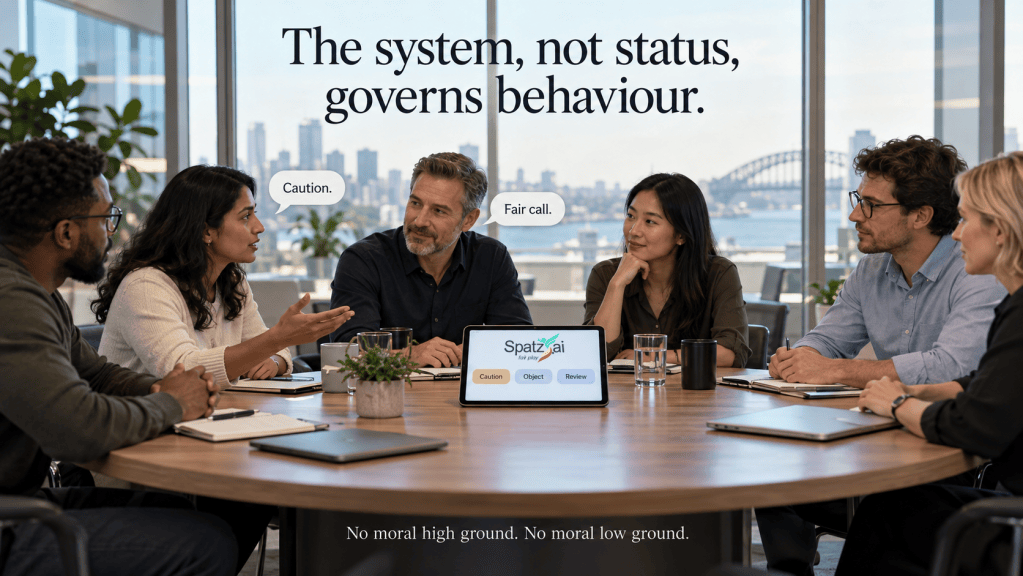
In the Spatz framework, a leader can caution a team member.
A team member can caution a leader.
Both are subject to the same behavioural standards and the same transparent Team + AI Review escalation process.
Leadership provides the buy-in — literally.
Leaders decide that change is needed, invest in the operating system, get people onboard and support its continued use.
Then everyone operates within the same process.
The leader does not have to embody the culture as some kind of behavioural saint.
The system provides the rules of engagement — and disengagement.
Leaders and team members participate on equal behavioural terms.
And their accumulated behaviour produces the culture.
The aim of the SpatzAI behavioural operating system isn’t to put managers on a pedestal — or put them out of a job.
It’s to stop so much of the small behavioural stuff becoming their job in the first place.
A True Level Playing Field
We think the job of a behavioural operating system is to create a framework for fairness:
No moral high ground. No moral low ground. A genuine level playing field when it comes to behaviour and course-correction.
That means:
- Leadership authorises, funds and buys into the system.
- Everyone agrees to participate in it.
- The system, not status or position, governs and safeguards behavioural standards.
- Leaders and team members are equally accountable to the process.
- Culture emerges from what people repeatedly practise, permit, correct and reinforce.
Perhaps that is the fundamental shift:
Instead of asking leaders to create and model culture, give everyone an agreed system for creating it together.


Leave a Reply