I recently came across a useful distinction between a hypothesis and a theory.
A hypothesis is a testable proposition.
A theory is a developed explanation supported by substantial evidence.
That got me thinking about two other words I use a lot: framework and paradigm.
A framework is the structure we use to organise concepts, assumptions and questions.
A paradigm is broader again: the established way a field tends to understand a subject.
Which raises an interesting question for workplace conflict.
What if the common tendency to treat disagreement and conflict as almost the same thing is not merely a wording problem, but a framework problem — perhaps even, eventually, a paradigm problem?
The framework I’m using, for now, separates them.
Two people can have competing interests (not conflicting).
Those interests can produce a disagreement.
That disagreement can produce a challenge.
But a challenge can be fair or unfair.
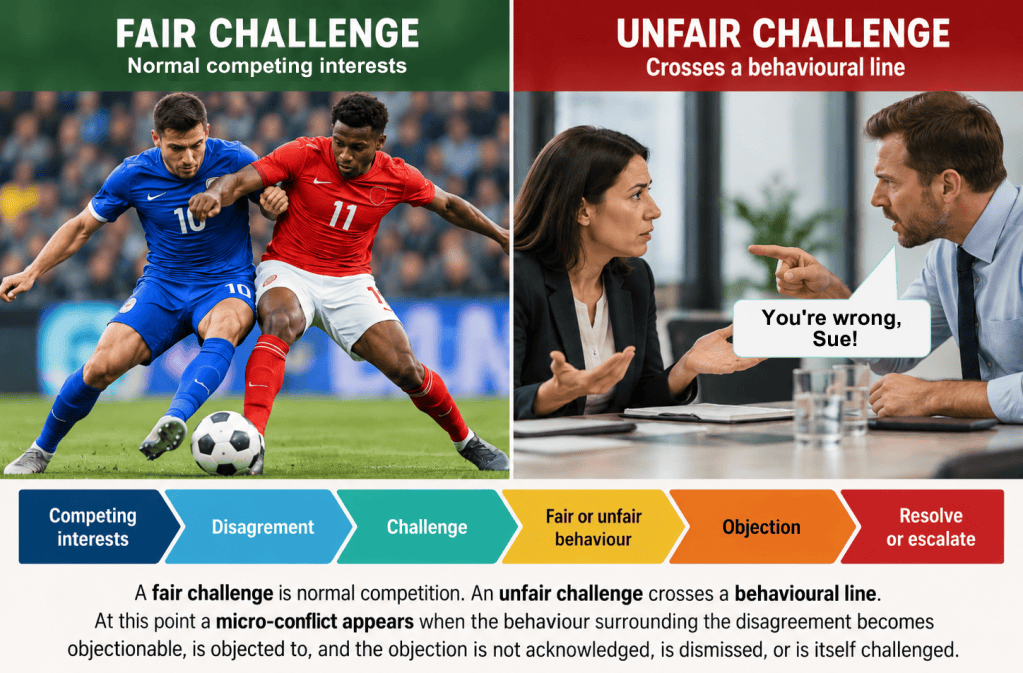
Think of a game of football.
Two players both want the ball. They clearly have competing interests. But we do not call that conflict. It is simply the game.
A fair challenge is normal competition.
An unfair challenge crosses a behavioural line.
That distinction seems useful in workplace teams too.
So the sequence might be:
Competing interests → disagreement → challenge → fair or unfair behaviour → objection → resolve or escalate
At this point a micro-conflict appears when the behaviour surrounding the disagreement becomes objectionable, is objected to, and the objection is not acknowledged, is dismissed, or is itself challenged.
Which is why I am increasingly uncomfortable with the expression “conflict of interest.”
In many situations, “competing interests” describes the condition more accurately without assuming conflict before any conflict has actually occurred.
Perhaps the hypothesis worth testing is this:
Every interpersonal conflict contains some disagreement, but not every disagreement becomes conflict.
If that holds up, then we may need to rethink not just how we resolve conflict, but what we call conflict in the first place.


Leave a comment