I accidentally ran a small experiment on a psychological safety survey.
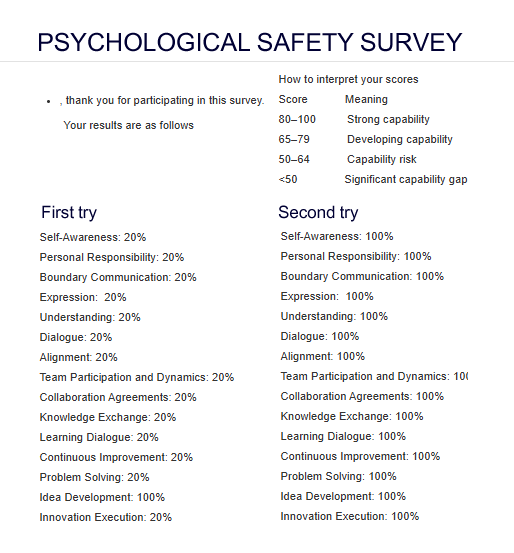
The first time I completed it, I misunderstood the response scale and selected “Strongly Disagree” for every question thinking it was agree.
My result: 20%.
Then I realised my mistake and did it again, selecting “Strongly Agree” for every question.
My result: 100%.
Apparently, in the space of a few minutes, I had transformed from a workplace disaster into a model of psychological safety.
Of course, I had done nothing of the sort.
What I had changed was not my behaviour, my workplace, or my relationships.
I had changed my answers.
That distinction matters.
The survey reported scores such as:
Self-Awareness: 100%
Personal Responsibility: 100%
Dialogue: 100%
Collaboration Agreements: 100%
Innovation Execution: 100%
But those numbers were really telling me something much simpler:
I had clicked “Strongly Agree.”
This does not make psychological safety surveys useless. Across a large enough group, anonymous surveys can reveal useful perceptions and patterns.
But I think we need to be careful about confusing reported perception with observed behaviour.
Someone may strongly agree with:
“People here feel safe disagreeing.”
The more interesting question may be:
Q: What actually happens when someone’s behaviour is problematic during a disagreement?
- Do people listen?
- Does the conversation deteriorate?
- Can someone object to their behaviour?
- What happens if the objection is not acknowledged?
- Does the situation resolve?
- What happens if it escalates?
- How long does resolution, if any, take?
That is the experiment I am increasingly interested in with SpatzAI.
Psychological safety surveys can tell us what people say they believe about the culture.
Behavioural systems may eventually help us observe what actually happens when the culture is tested.
My accidental 20%-to-100% transformation took about five minutes.
Unfortunately, I suspect real psychological safety takes a little longer.
PS: I work for myself and by myself, mainly so I am not a great candidate for this type of survey data.


Leave a comment