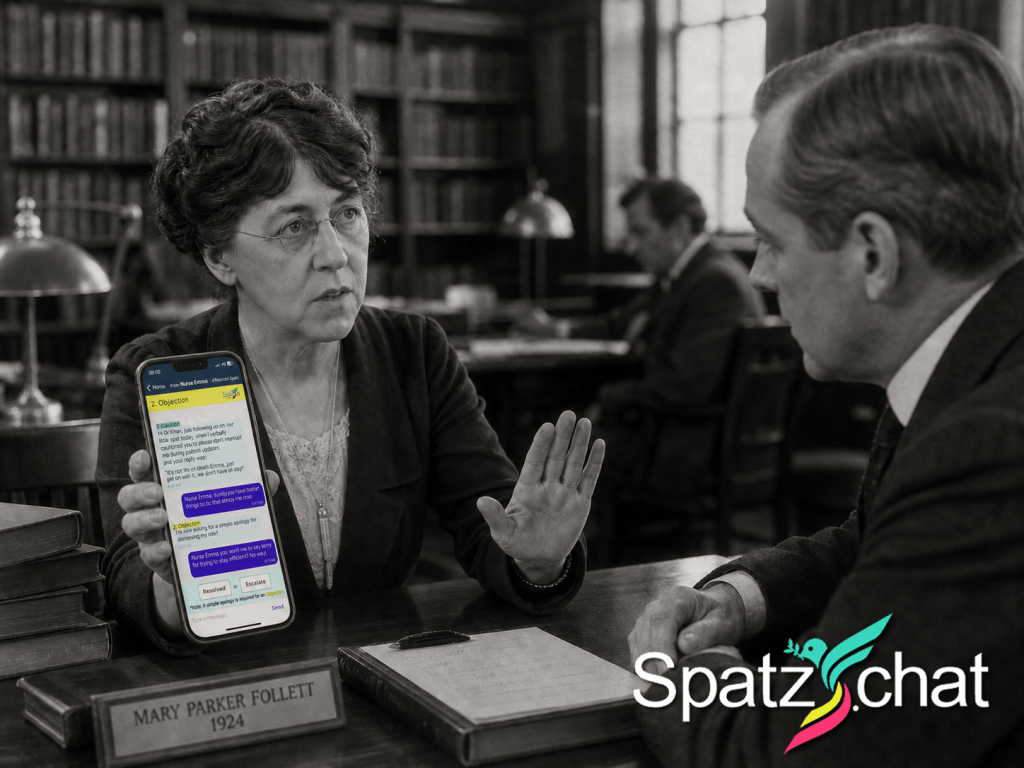
Mary Parker Follett was ahead of her time in how she understood disagreements and conflict.
By 1924, she had already articulated her framework of domination, compromise, and integration, later presented clearly in her 1925 paper, Constructive Conflict. She did not see conflict simply as something to suppress or avoid. Instead, she saw it as a possible source of learning, creativity, and mutual understanding. For Follett, the way people responded to conflict mattered. They could dominate, compromise, or integrate
- Domination is where one side wins and the other loses.
- Compromise is where both sides give something up.
- Integration is where both sides work through the difference until a better shared solution appears.
I believe SpatzAI sits close to Follett’s idea of integration, but with a more specific and procedural focus.
Follett looked at how disagreements can be resolved.
SpatzAI looks at what happens inside the disagreement before fair resolution becomes possible.
In my view, every disagreement has at least two layers.
The first is content and context: what is being discussed, the evidence, the timing, the risk, the interpretation, the missing information, or the decision itself.
The second is behaviour and delivery: how the disagreement is being expressed, the tone, pressure, interruption, dismissiveness, dogmatism, impatience, or attempt to force agreement.
This is where I think SpatzAI team playbook adds something unique.
Follett’s domination is close to what I call conversion. One person is trying to impose their view, rather than explore the issue.
Follett’s integration is close to what I call convergence. Both people remain open enough to be changed by the interaction.
The SpatzAI team charter encourages us to watch for this shift, in real-time.
The question we are encouraged us to ask during conversation is, “are we still converging, or has someone started converting?”
Once the behaviour becomes unruly: i.e. overly dogmatic, SpatzAI allows us to separate this behaviour from the disagreement itself. The content of the disagreement may or may not still be valid. It may need more information, or it may just remain unresolved, while, in the meantime, we are trying to resolve our spat.
However, I believe, for best results, the behavioural micro-conflict should be resolved as soon as possible.
Once that friction is addressed, and resolved the disagreement can return to being just that: a disagreement. Something to clarify, dispel, or hold open until more or better information arrives.
 Object123
Leave a comment