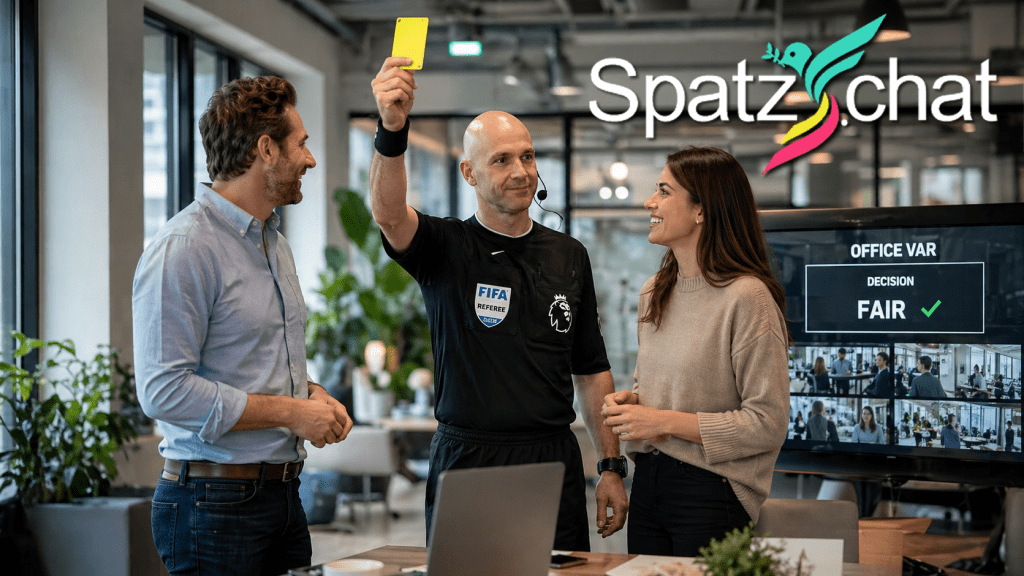
I think workplace teams need something soccer has had for more than 50 years: a clear, agreed way to intervene when play becomes unfair, unsafe, or unclear.
- Referees in association football: since the late 19th century, roughly 130+ years.
- Yellow cards: introduced at the 1970 FIFA World Cup, so roughly 55+ years.
- VAR: first widely trialed in the mid-2010s and used at the 2018 FIFA World Cup, so roughly 8–10 years.
In soccer, the referee does not wait until the match is over or contact the player the following week to review their fouls. They step in during play, as it happens. Sometimes it is just a quiet word. Sometimes it is a whistle or a card. And when the decision is disputed or serious, VAR – Video Assisted Referee, can help review what happened.
Workplace teams need a similar kind of real-time fairness.
Not because people are bad.
Because difficult conversations move quickly. Tone shifts. Interruptions happen. Pressure builds. One person feels unfairly challenged. Another feels attacked by the response. A third thinks it is just a robust debate.
Without an agreed process, these moments either get ignored, suppressed, personalised, gossiped about, or escalated later as anonymous complaints.
SpatzAI is my attempt to give teams their own personal, real-time referee and review system.
It starts with a simple team agreement: if someone experiences behaviour as overly dogmatic or objectionable during a conversation, they can raise it fairly, in the moment.
First, a 0. Verbal Caution.
Then, if needed, an 1. Official Caution, using the SpatzChat app
Then an 2. Official Objection, using the SpatzChat app
Then an 3. Official Stop and Review, using the SpatzChat app and Team + AI Review platform.
The aim is not punishment. The aim is course correction using appropriate levels of accountability.
ie. Acknowledge – Simple Apology – Acceptable Apology
Their team can then review the AI summation of the behaviour, the context, and the delivery, rather than relying only on hearsay, memory, status, or who argues best after the event.
I think this is how behaviour can begin to change from the ground up.
Not through posters on walls.
Not through values statements.
Through fair, real-time intervention when teamwork actually happens.


Leave a Reply