For far too long, sloppy management language has blurred distinctions that should never have been blurred. Experts, consultants, and workplace commentators keep praising “healthy conflict” and “productive friction” as if damage and discipline were the same thing.
In my view, they are not.
I believe that this kind of language confuses teams, lowers standards, and normalises behaviour that should be recognised early for what it is. If we want teams to think clearly and work fairly, we need a cleaner lexicon, because once we start calling friction healthy and conflict constructive, we stop noticing the point where useful challenge has already begun to turn into harm.
Words matter, especially when they hide the line between what helps a team and what harms it.
Two distinctions clear up a lot of the confusion.
1. Tension is not Friction.
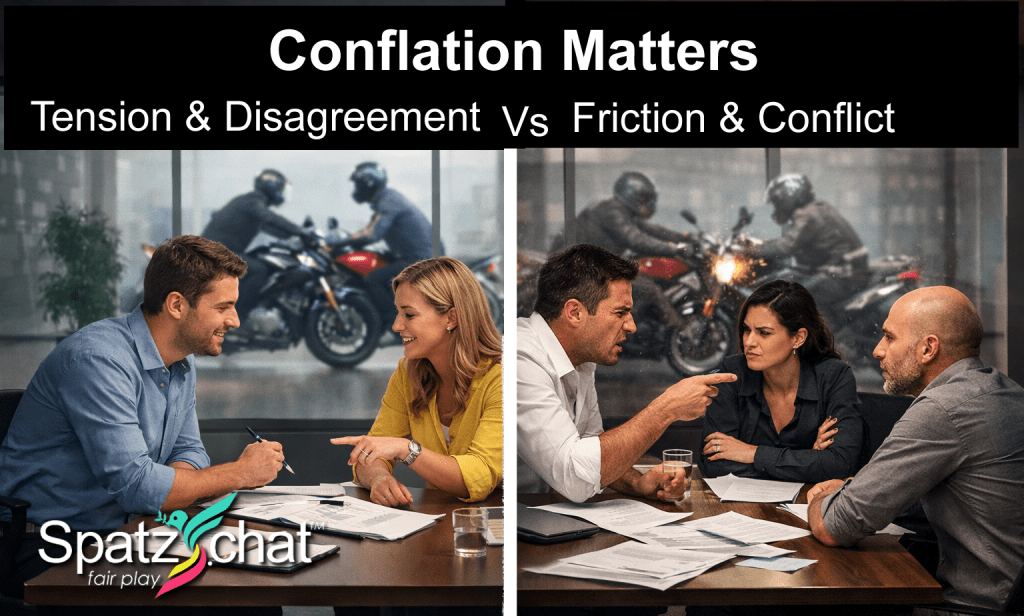
Tension is pressure without damaging contact. It is the near miss, the closeness, the stretch, the challenge. In a good team, tension can be useful. Ideas press close to each other. People test assumptions. Views differ. Nothing is being scraped or damaged yet.
Friction is different. Friction means contact that causes drag, wear, heat, or damage. Think of two motorbikes. If they pass close, there is tension. If they touch, there is friction. Even the lightest contact usually leaves a mark. At minimum, some paint is gone.
2. Disagreement is not Conflict.
Disagreement is a difference in view. It can be thoughtful, direct, and productive. Conflict begins when the interaction around that difference starts to deteriorate. The problem is no longer the idea itself, but the behaviour surrounding it. Interruption, sarcasm, defensiveness, coercion, dismissal, retaliation. That is conflict.
This matters because many experts still use phrases like healthy conflict or productive friction when they really mean healthy tension or constructive disagreement. Once the issue is framed more carefully, those phrases start to collapse under their own contradiction. Properly framed, healthy conflict and productive friction are oxymorons.
That is not a small wording issue. It blurs the threshold where teams should act. Is it any wonder teams struggle daily with friction and conflict when the language used to describe them is already so muddled?
If we call friction healthy, we tolerate damage.
If we call conflict constructive, we romanticise deterioration.
I believe that a better model is simpler:
Disagreement can create tension.
Tension can be constructive.
Mismanaged tension becomes friction.
Unresolved friction can escalate into serious conflict.
Teams do not need more confusion here.
They need clarity and a cleaner lexicon.
Protect disagreement.
Value tension.
Address friction early.
Prevent conflict before it hardens.
 Object123
Leave a comment