I think the future of teamwork may belong to teams that can disagree well, not avoid disagreement.
As AI takes over more routine, analytical, and repeatable work, the human advantage may lie elsewhere. Not in being faster. Not in being more efficient. But in being able to bring different instincts, values, doubts, experiences, and judgments into the same room and work through them productively.
Human beings are messy. We bring ego, humour, fear, courage, intuition, insecurity, flawed memory, and self-interest into our conversations. That mess can create friction, but it can also create originality. It helped us design, invent, and build the very systems now reshaping work, including AI itself.
I think that creative spark still matters.
The challenge is that messy disagreement can just as easily become avoidance, politics, intimidation, or conflict. So the issue is not whether teams will disagree. They will. The issue is whether they can do so fairly, in real time, while the work is still unfolding.
That is where governance comes in.
Not top-down control. Not vague appeals to psychological safety. Not waiting until damage has already been done.
Real-time fairness.
Teams need a simple and fair way to caution, object, respond, apologise, and review behaviour before tension turns into something more corrosive friction. In my view, that is the missing layer in modern teamwork.
As AI becomes more capable, the teams that matter most may be the ones that can hold human difference together long enough for better ideas to emerge.
I also do not believe AI, now or in the near future, would have produced the Spatz Playbook in its current form, with all its quirks, distinctions, and six radical principles. That has come from 40 years of slow human thought.
I think the future of teamwork may still depend on three distinct contributions: the lone human who originates an idea through long reflection, the real team that pressure-tests it through lived disagreement, and the AI that helps refine, scale, and evolve it faster.
That is why I think real-time fairness may become a competitive advantage.
Teams that learn to disagree well may move forward.
Teams that do not come onboard may be left behind.
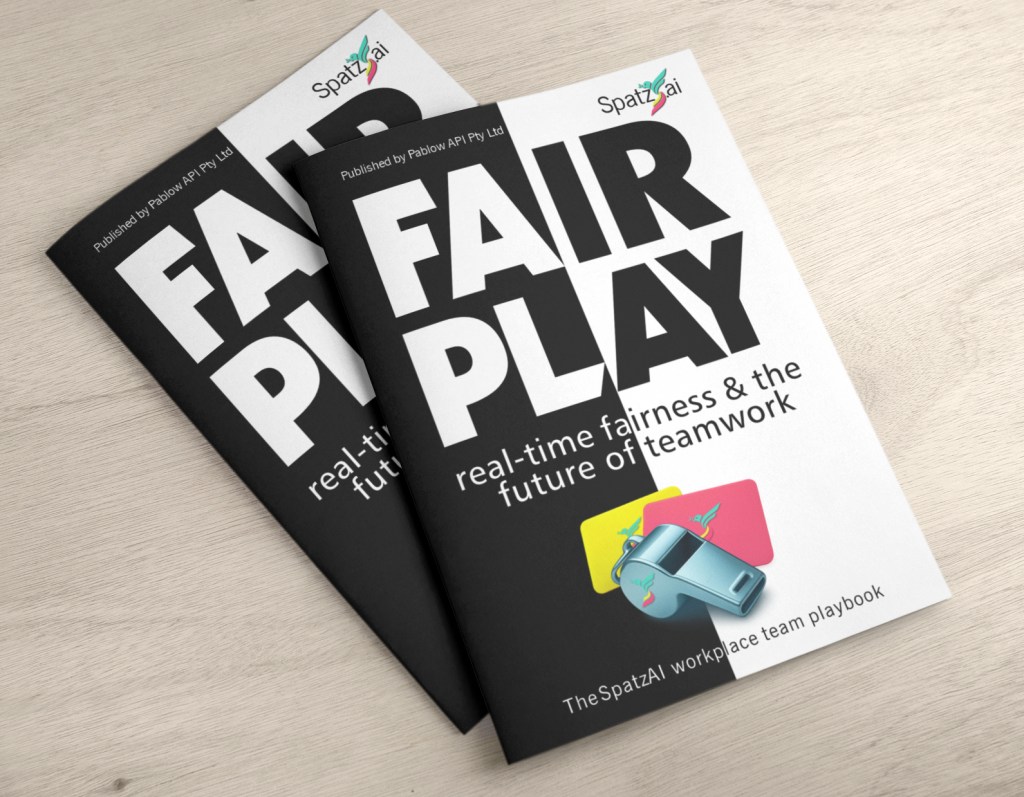
P.S. One hidden advantage of a digital playbook is that it can evolve at a speed printed systems never could. A change that once might have taken 20 months to appear in a revised edition can now be made globally in 20 seconds, around 2.6 million times faster. That means teams are not stuck waiting years for clarifications, improvements, or refinements. They can propose amendments through lived use, while the playbook itself remains a living framework, updated in real-time rather than frozen in print


Leave a Reply