Most of us were taught that when uncomfortable friction arises during a disagreement, we only have three responses to consider:
- Fight
Push back using a tit-for-tat reaction. - Flight
Step away. Avoiding the moment, and sweeping it under the carpet. - Freeze
Get stuck. Go silent. Ignoring the situation and shutting down.
Our reactions to discomfort seem to have kept our ancestors alive. However, they do not appear to serve modern workplace teams, where professional and disciplined collaboration depends on staying in the conversation without emotionally impinging on one another.
So I am suggesting that the modern-day, professional alternative response is to flag – green, yellow and red flags, to address the offending behavior in real-time. As used in Formula One, the red flag to stop the race, the yellow flag to warn of a hazard, the green flag to show the track is clear but be cautions.
- Flagging (as in Red Flag)
The challenge with flagging in the past is that most of todays organisations have not kept up with psychology and technology. By providing tools and a transparent process to support calling out when a team member infringes, team members can now be confident that they will be protected when raising even minor issues.
Designed from the ground up, the SpatzAI Toolkit, includes the following:
- The Spatz Team Charter
- The Spatz Fair Play Playbook
- The SpatzChat app
- The Spatz Team and AI-assit Review plugin
- The Spatz AI Large Language Model
0. Verbal Caution – Green Flag (pause discussion)
- The team member who felt their teammate was playing up issues the Verbal Caution.
- If the receiver of the caution wasn’t aware of their behavior, a brief explanation is given.
- The conversation pauses until there is a simple acknowledgment.
- Then play on. If the flag is downplayed, the Issuer can escalate their spat using the SpatzChat app.
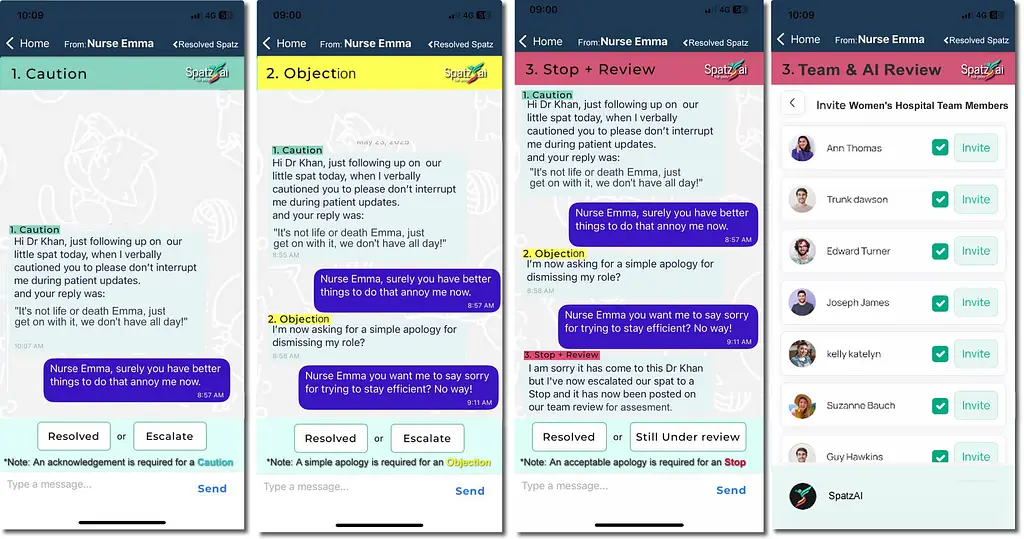
1. Formal Caution – Cyan Flag (using SpatzChat app)
- At a convenient time, the issuer sends the formal caution, messaging their teammate using the SpatzChat app and formally documenting their previous verbal caution on the app.
- The person being cautioned must acknowledge the infringement (via the SpatzChat app), and teamwork can resume.
- If the caution is still downplayed, the next phase (Formal Objection) is triggered by the issuer pressing the escalate button on the app.
2. Formal Objection – Yellow Flag (using SpatzChat app)
- Once again, the Issuer uses SpatzChat to send a formal objection or yellow flag:
- The infringing person must respond using the SpatzChat with a simple apology and they move on, or if downplayed, yet again, the issuer can up the ante once again, to a Formal Stop.
3. Formal Stop – Red Flag (SpatzChat app + Team & AI-Assisted Review)
- The issuer presses Escalate in SpatzChat.
The objection becomes a Formal Stop, and the documented micro-conflict is automatically posted to the Spatz Team & AI-assisted Review plugin on Slack, where both the team and the Spatz AI can help restore fairness. - If no acceptable apology or resolution emerges, the issue and data moves to the organisation’s more serious and standard conflict resolution process, such as Nøgd.
In essence, introducing the concept of “flagging” moves us beyond the instinctive trio of fight, flight, or freeze. It gives teams a structured and safe way to pause, address friction, acknowledge it, and move forward. By agreeing to embed clear signals and a built-in process for escalation when needed, we create an environment where issues are surfaced in real time, handled respectfully, and resolved before they fester. With this approach, professional collaboration becomes the norm—not the exception.
 Object123
Leave a comment