A Fictional Research Case Study Based on using the SpatzAI Chat App Data
As we move closer to October—Safe Work Australia Month—I wanted to share a glimpse of what the future could hold for workplace conflict resolution. This post is a demonstration of how SpatzAI’s structured approach to addressing micro-conflicts could transform team dynamics. Using data from a simulated pilot, where we’ve predicted the outcomes, we can see the potential “real-world” impact of tackling minor workplace spats early—during disagreements—before they escalate into full-blown, toxic conflicts. Later this year, when the Spatz Chat app and team review platform officially launches, teams will have the opportunity to experience firsthand how fairer, more structured conversations can lead to healthier, more collaborative work environments.
Abstract
Workplace teams often struggle with unaddressed minor conflicts (spats), which can escalate into disputes and full-blown conflicts, negatively impacting collaboration and productivity. This study explores the hypothesis that addressing spats early and directly can reduce the number of escalating conflicts, ultimately creating a culture of more constructive dialogue and improved teamwork. Using data from a week-long pilot of the Spatz Chat app with a team of 100 employees, we analyzed the effectiveness of SpatzAI’s structured Caution-Objection-Stop process in mitigating conflict escalation. Our findings suggest that early intervention at the verbal caution stage significantly reduces the likelihood of conflicts escalating into disputes or requiring formal resolution mechanisms. These results indicate that structured micro-conflict resolution mechanisms can play a critical role in enhancing psychological safety and collaborative effectiveness in workplace teams.
1. Introduction
Workplace conflicts are inevitable but often poorly managed, leading to toxic environments, reduced engagement, and lower productivity (Gelfand et al., 2012). Traditional conflict resolution frameworks typically focus on disputes that have already escalated, leaving minor conflicts unaddressed until they become severe. SpatzAI’s Chat app was designed to intervene early by enabling employees to issue verbal cautions and escalating only when necessary. This study examines whether such an approach can minimize full-scale conflicts while increasing the frequency of difficult yet productive conversations, ultimately enhancing collaboration.
Our primary research question is: Can structured early self-intervention in minor workplace spats reduce conflict escalation and improve team collaboration?
2. Methodology
We (will) conducted a pilot study using Spatz Chat over one week with a team of 100 employees. SpatzAI’s three-step process—Caution, Objection, and Stop—was used to document and resolve micro-conflicts. The dataset collected included:
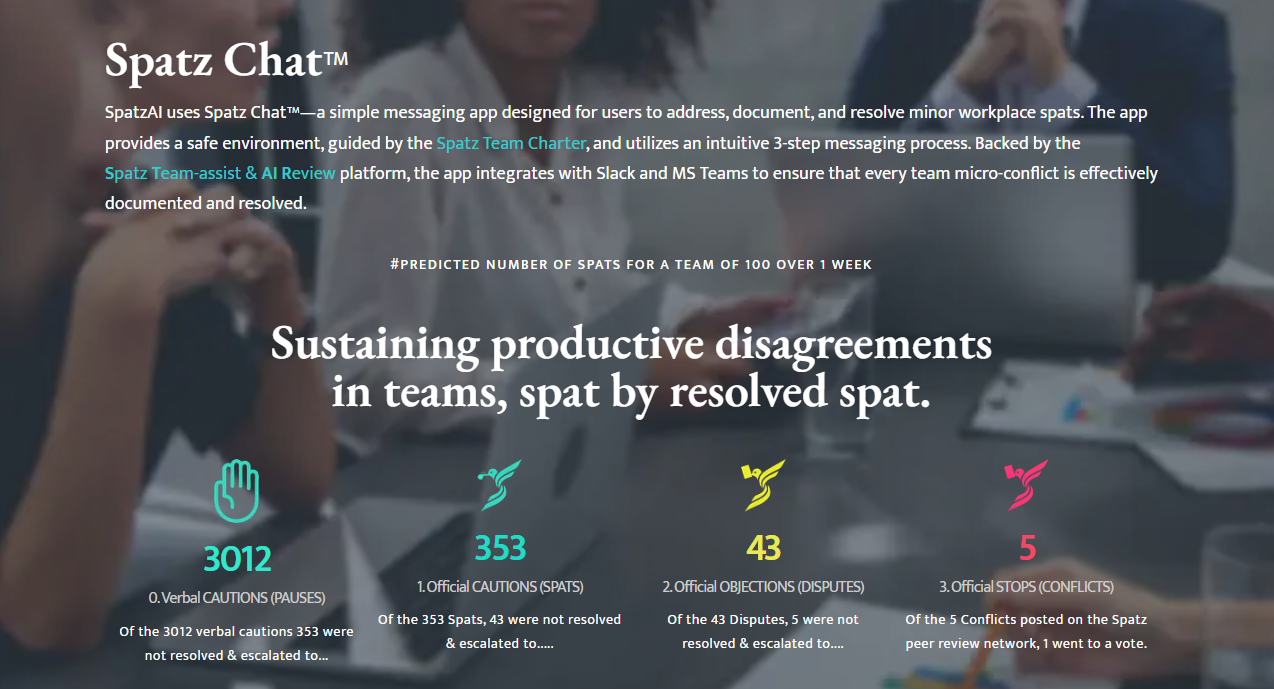
- Verbal Cautions (Pauses): 3,012 (collected from surveys)
- Official Cautions (Spats): 353 (11.7% of verbal cautions escalated – data collected from app )
- Official Objections (Disputes): 43 (12.2% of official cautions escalated – data collected from app)
- Official Stops (Conflicts): 5 (11.6% of official objections escalated – data collected from app)
- Team/Peer Review Votes: (1 case required peer voting – data collected from Slack platform)
Each escalation point represents an increase in severity, requiring additional member’s intervention and the other’s accountability. The data was analyzed to determine the percentage of conflicts that were de-escalated or resolved at each stage, shedding light on the effectiveness of early spat resolution.
3. Results
The results support our hypothesis that early intervention significantly reduces conflict escalation:
- Most issues were resolved at the verbal caution stage.
- Out of 3,012 verbal cautions, only 353 (11.7%) escalated to official cautions, meaning 88.3% of issues were resolved informally.
- Few spats escalated into disputes using an official objection.
- Out of 353 official cautions, only 43 (12.2%) were not resolved and escalated to official objections.
- Even fewer disputes escalated to full conflicts, using an official stop.
- Out of 43 objections, only 5 (11.6%) became official stops, requiring team review.
- Formal peer voting was rarely needed.
- Only 1 out of 5 conflicts under review required a team vote, suggesting that even the most severe cases could often be resolved before reaching this stage.
These findings indicate that early intervention mechanisms prevented the majority of spats from escalating into disruptive disputes or conflicts. By enabling direct and structured resolution, SpatzAI helped increase difficult but constructive conversations while reducing the psychological toll of prolonged unresolved tension.
4. Discussion
4.1 The Power of Early Intervention
The data suggests that workplace conflicts are best managed at their earliest stages. Enabling employees to address spats at the verbal caution level prevented 88.3% of incidents from escalating. This supports the idea that micro-conflicts, if managed proactively, can be contained before they become organizational liabilities (Edmondson, 1999).
4.2 Psychological Safety and Team Collaboration
Amy Edmondson’s (1999) concept of psychological safety highlights that teams with high levels of trust and open communication tend to perform better. Our findings will reinforce this idea, showing that teams empowered with structured micro-conflict resolution tools are more likely to engage in candid, direct, and constructive dialogue rather than letting issues fester.
4.3 Reducing the Fear of Retaliation
Traditional HR-driven conflict resolution processes often involve high stakes and fear of retaliation, discouraging employees from speaking up. SpatzAI’s gradual escalation model (Caution → Objection → Stop) allowed for low-risk interventions. Self-managing their micro-conflicts and have the team review them, when necessary, bypasses hierarchical overview, diffusing the power imbalance and making employees more comfortable addressing minor conflicts without the fear of immediate consequences.
4.4 More Difficult Conversations, Fewer Full-Scale Conflicts
While the SpatzAI system encouraged more difficult conversations, it reduced destructive conflict escalation. This aligns with research by Patterson et al. (2002) on crucial conversations, which emphasizes that workplaces fostering open, structured dialogue experience fewer breakdowns in team cohesion.
5. Conclusion & Implications
We believe our study will provide strong evidence that early minor spat resolution reduces conflict escalation and enhances team collaboration. The structured approach offered by SpatzAI’s Spatz Chat app system allows teams to engage in more difficult but constructive conversations, leading to better workplace dynamics.
Key Takeaways:
- Addressing micro-conflicts early prevents escalation.
- A structured intervention model increases team psychological safety.
- Encouraging more difficult conversations leads to improved innovation and fewer high-stakes disputes.
- Low-risk self-managed conflict resolution reduces fear of retaliation, improving participation.
Future Research & Implementation
Future studies could expand on this research by analyzing longitudinal data across multiple teams and industries. Additionally, organizations may consider integrating SpatzAI into broader HR and team management strategies to build cultures of open, constructive dialogue.
References
- Edmondson, A. (1999). Psychological safety and learning behavior in work teams. Administrative Science Quarterly, 44(2), 350–383.
- Gelfand, M. J., Leslie, L. M., Keller, K. M., & de Dreu, C. K. (2012). Conflict cultures in organizations: How leaders shape conflict cultures and their organizational-level consequences. Journal of Applied Psychology, 97(6), 1131.
- Patterson, K., Grenny, J., McMillan, R., & Switzler, A. (2002). Crucial Conversations: Tools for Talking When Stakes Are High. McGraw-Hill.
- Susannah B. F. Paletz, Joel Chan, Christian D. Schunn, The dynamics of micro-conflicts and uncertainty in successful and unsuccessful design teams
This future research will demonstrate, we believe, that the transformative potential of structured, team-led conflict resolution in reducing destructive conflicts while increasing the quality of difficult workplace conversations. By implementing SpatzAI’s 3-Step Caution-Objection-Stop process and team review model, organizations can create fairer, more collaborative teams that thrive on productive disagreements rather than unresolved tensions.
 Object123
Leave a comment