Psychological safety is discussed almost daily on LinkedIn. Yet, in 2026, we still lack the clarity of a widely recognised, standard procedure for challenging objectionable behaviour during everyday workplace conversations.
For example: With psychological safety we ask the following and hope/believe we are going to be safe.
“how is someone going to react if I speak up?”
However, I think we could ask the following and know that the system and our team has our backs.
“have I/we got this, when they react after I object to their behaviour? “
Reactions are inevitable. People will occasionally react defensively, dismissively or even unfairly when challenged, fairly or unfairly, regardless of their culture, training or good intentions.
Having an agreed procedure and system in place, as a global standard, to address objectionable reactions, when they occur, is key, I believe.
In a recent LinkedIn exchange, someone challenged my proposal for a global standard, arguing that people, cultures and organisations differ. What works for one team may not work for another.
A reasonable concern. But I think it overlooks an important distinction.
We don’t need everyone to agree on what constitutes objectionable behaviour. We need everyone to agree on what happens when someone objects.
Consider aviation. Pilots from different cultures operate under internationally recognised procedures.
Or football. Players don’t always agree with the referee, but they agree to play under common rules, and abide by the ref’s decision.
And consider Uber or Grab. They’ve made requesting transport a familiar, standardised process across different countries and cultures. Just like they can do it on a global scale with ride-sharing, just maybe we can do it in the workplace with objection-sharing.
Why couldn’t we establish something similar for workplace objections?
Imagine a globally recognised brand and procedure that becomes the natural go-to whenever someone experiences minor objectionable behaviour during a workplace conversation.
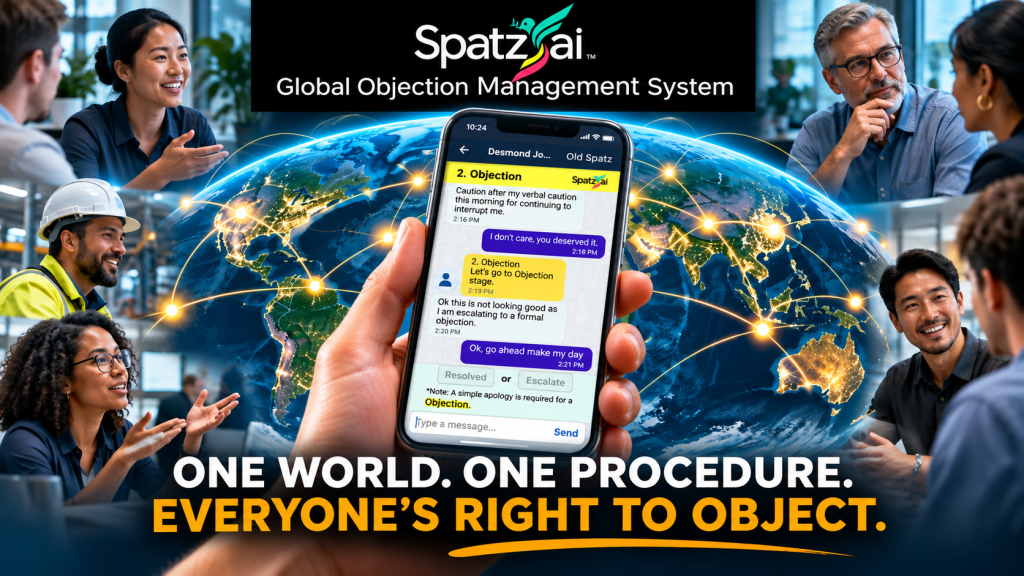
That’s our ambition with SpatzAI — a Workplace Objection Management System.
Our approach has three parts:
- Verbal Caution: One signals, in real-time, that there is objectionable behaviour, allowing immediate acknowledgement and resolution.
- Formal App Escalation: If the caution is ignored or challenged, use a proportionate 3-step procedure chat app to resolve or escalate.
- Optional Team + AI Review: When necessary, if still unresolved, examine disputed behaviour, proportionality and accountability.
The procedure is standardised. Individual behavioural boundaries are not. Team members can discuss what they, as a team, object to, or behaviour they find acceptable within the team context and workplace time. And of course this can vary within any team, in any country. It is their decision and their culture.
Agreeing to use the Spatz team charter and playbook, lets everyone have the same right to object, regardless of position, culture or personality.
Will this eliminate unfair reactions? Of course not.
But instead of relying on everyone to react fairly, we can establish what happens when they don’t.
Until we develop a globally recognised standard and brand for addressing everyday workplace spats, I believe we’ll continue relying on inconsistent, improvised responses, often after minor friction has escalated into serious conflict.
Psychological safety asks us to make speaking up safer. SpatzAI proposes a procedure for dealing with what happens after we speak up.
SpatzAI — Helping Teams Object Well.


Leave a Reply