I recently came across three popular principles about workplace culture:
What you tolerate becomes the standard.
What you ignore becomes permission.
What you repeat becomes the culture.
I suspect the word “you” in these statements is primarily directed at the leader or manager.
And therein lies what I believe is a fundamental problem.
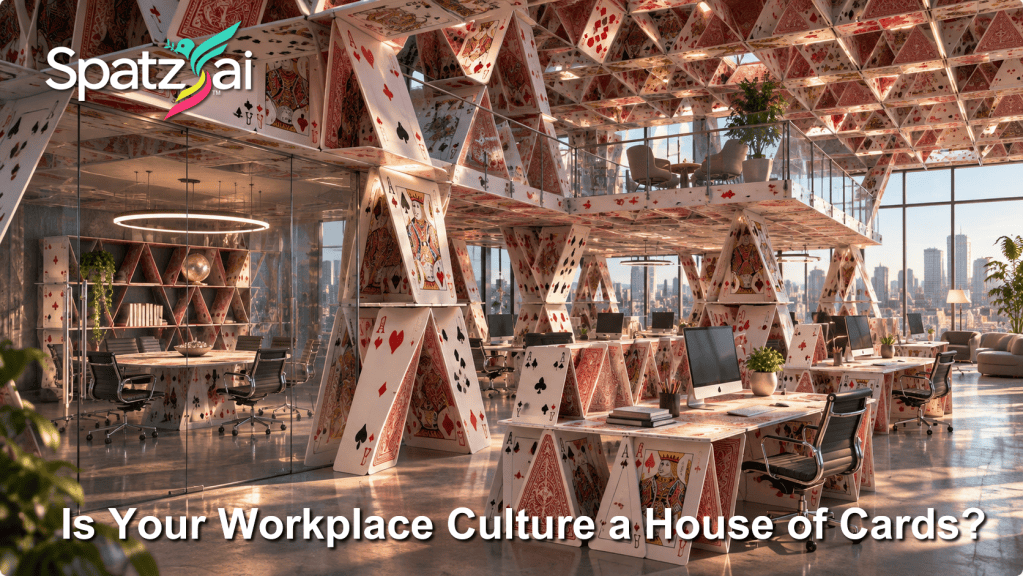
Are we building workplace cultures or houses of cards?
If the leader determines what behaviour is tolerated, ignored or repeated, then the team’s culture becomes heavily dependent on one person, the leader’s personal judgement, preferences and behaviour.
What happens when the leader makes a mistake? What happens when their behaviour becomes objectionable? And what happens when they leave?
The stronger the leader’s influence, the more dependent the team may become on that individual.
That sounds to me like a rather fragile architecture.
For the past several years, I’ve been developing an alternative framework through SpatzAI, based on three different principles:
1. What behaviour one objects to becomes the standard.
2. What accountability one accepts becomes permission.
3. What behaviour and accountability that gets reviewed, by the team, becomes the culture.
The distinction is that every team member, regardless of rank, has the same procedural right to caution, object and escalate to the other’s behaviour when necessary.
An objection can be acknowledged, accountability accepted and collaboration resumed.
When a matter cannot be resolved between individuals, an optional Team + AI Review provides a mechanism for collectively examining what is fair.
The AI then becomes a repository of the team’s evolving behavioural culture, rather than an authority dictating it.
The leader remains an important member of the team, but is no longer the sole referee of everyone’s behaviour.
Of course, this is a developing framework that still needs independent field trials.
But I believe it raises a fundamental question:
If your workplace culture collapses when the leader leaves, was it ever genuinely the team’s culture?
Perhaps it’s time we stopped building workplace cultures around personalities and started building them around agreed systems of reciprocal accountability.
SpatzAI — Helping Teams Object Well.


Leave a Reply