Organisations encourage their team members to be more objective, or less subjective, less judgemental, with an open mindset. But how does one actually become more objective?
Some 10 years ago I asked myself this question and answered with a joke: “learn to object well!”
After my brief chuckle, I pondered this answer and it began to dawn on me that this could actually be true.
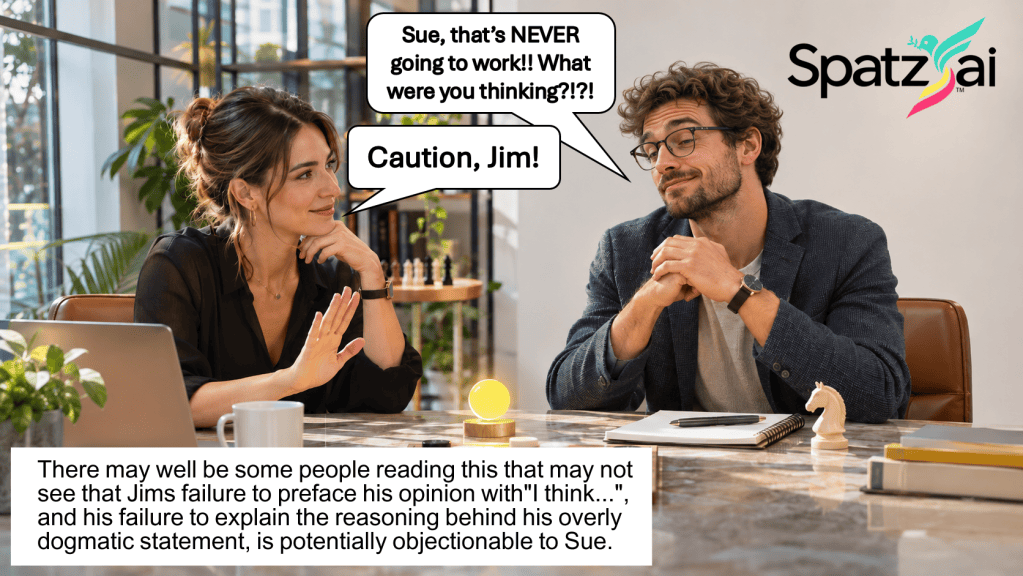
Imagine Sue and Jim discussing a workplace problem. Jim repeatedly interrupts Sue and abruptly dismisses her suggestions without valid reasoning. Sue feels disrespected, but that may well be her subjective interpretation. And Jim may see things differently, also.
Rather than remaining silent, complaining later to he manager or escalating the issue to HR, Sue says one word to Jim:
“Caution!” (one of the mildest forms of objection).
Having been onboarded and agreed to the SpatzAI FAIR PLAY Workplace Team Charter and Playbook, Jim knows he can acknowledge Sue’s caution, challenge it or simply ignore it, without worrying about being unfairly reported.
Their disagreement is momentarily paused while Sue’s concern about his behaviour is addressed. Once resolved, they can resume their discussion, even though they may still disagree.
Here’s the important distinction: we disagree with the content of someone’s argument, but object to behaviour or delivery that we deem objectionable.
Sue’s caution doesn’t prove Jim behaved unfairly. It makes her concern explicit and open to examination.
Perhaps Jim was interrupting. Perhaps Sue misunderstood his intentions. Perhaps both have something to learn.
If they cannot resolve the behaviour issue, SpatzAI offers proportionate escalation using the SpatzAI 3-step chat app and a final Team + AI Review, if still required. Neither person’s judgement is automatically correct, and neither is above review.
The team doesn’t need to agree on everyone’s behavioural boundaries in advance. Individuals have different boundaries; what they do share is a fair, reciprocal process for expressing, acknowledging and examining behavior and any objections to it.
Now imagine a team practicing this regularly.
Might members become better at separating observable behaviour from subjective interpretation? More willing to reconsider assumptions or dogmatic assertions? And might they be more accountable for how they treat one another?
Those outcomes require testing. Objecting can be biased or unreasonable too, of course. But a transparent process makes course-correction of either possible.
I’ve long argued that conversation ought to be about converging rather than converting. Learning to object well could help us do that, especially when conversations become uncomfortable and friction creeps in.
Perhaps objectivity is not only an individual quality. Perhaps it can also emerge through a designed process of reciprocal accountability.
Objectivity via objecting to objectionable behaviour.


Leave a Reply