
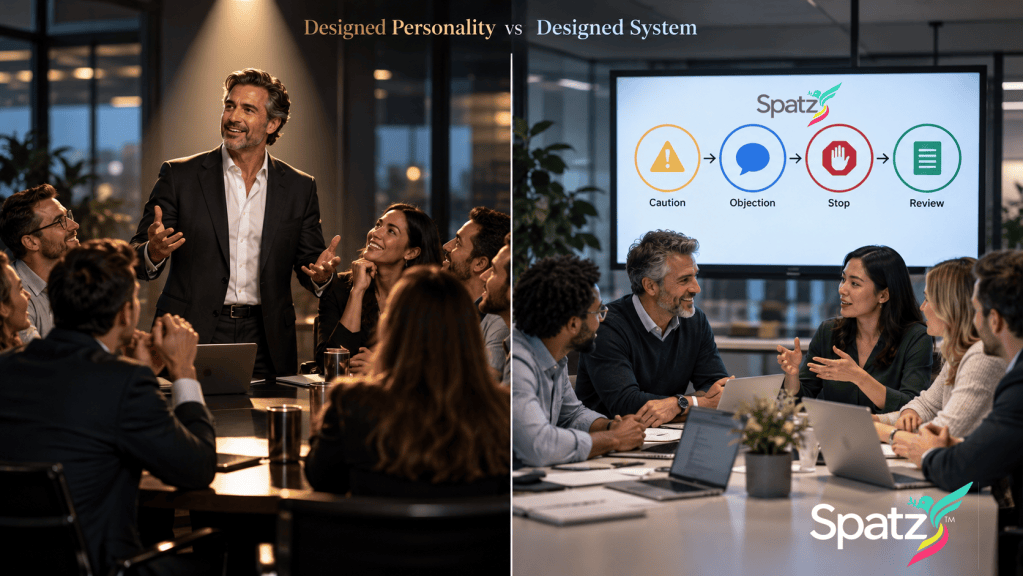
I think there are two very different ways to approach workplace culture.
The first is the familiar leadership-modelling solution.
Leaders are expected to model respectful behaviour, set the tone, reinforce values, correct poor behaviour, resolve disputes and somehow embody the culture everyone else is expected to follow.
At its best, this can work remarkably well.
A strong leader can create a strong culture.
But that also reveals the weakness.
The culture becomes heavily dependent on the judgement, consistency, temperament and personality of the leader.
Change the leader and you may change the culture.
Taken too far, it can start looking suspiciously like a personality-cult solution: find the right person, train them well enough, surround them with coaches, and hope everyone follows.
The alternative is a designed-systems solution.
That is the idea behind Spatz™.
Team members agree in advance how minor behavioural issues can be raised, acknowledged, challenged, resolved, escalated, documented and reviewed.
Instead of asking one person to carry the culture, design a process that everyone agrees to use.
Spatz™ gives every team member a standard way to address minor objectionable behaviour when it happens. A person can issue an early verbal caution; the other person can acknowledge it or challenge it. If the behaviour is not resolved, the issue can be escalated proportionately, using the Spatz™ chat app for issuing a more formal caution, objection and stop, if needed. If their spat still cannot be resolved, their now documented interaction is automatically posted onto their team Slack channel to be openly reviewed by their team and AI.
The leader still matters as they still have to buy into the idea, pay for the already-designed operating system and agree along with the team to use it.
Managers no longer have to be the team’s behavioural nanny or operating system.
That is the distinction. It allows managers to focus on what they do best — management: setting direction, making strategic decisions, allocating resources, coordinating work, removing obstacles and helping the team perform effectively.
Airlines do not rely entirely on having exceptionally calm pilots. They build procedures, checklists and software systems around human behaviour.
Factories do not rely entirely on exceptionally vigilant managers. They use their teams as early warning systems, alarms, controls and stop mechanisms.
So perhaps workplace culture deserves the same treatment.
Not:
Find better personalities or train these people to behave better.
But:
Design better behavioural systems.
Spatz™ is only a proposed solution and still needs testing.
But at least the proposition is clear:
Culture should depend less on who is leading and more on the system everyone has agreed to use.


Leave a Reply