Speaking up, speaking down, giving feedback, challenging an idea; what do they all have in common?
They are things organisations say they want people to be able to do.
Yet employees can hesitate to speak up because of the possible cost.
And managers can struggle to speak down without it becoming talking down.
There is an important distinction.
Speaking down:
“I need you to correct and redo this section. The figures don’t match the source data, and we need it corrected before the report goes out.”
Talking down:
“How the hell did you manage to get something this basic wrong? I shouldn’t have to explain this to you.”
There is an equivalent problem in the other direction.
We encourage employees to speak up, but speaking up can also become what we traditionally call talking back.
So perhaps the distinction here is:
Speaking up:
“I don’t agree with that decision. I think it creates a safety risk because we haven’t tested the new process properly.”
Talking back:
“That’s absolutely ridiculous. You clearly haven’t thought this through, and I’m not doing it just because you say so.”
So, Now I hear some of you say the following:
“Oh, so now you want people to speak up, but you’re going to be picky about how they do it?”
Picky, yes. Punitive, no. The aim is simply to course-correct when one of us errs in our delivery NOT the content.
Because having the right to challenge someone does not provide immunity for how we behave while doing it.
An employee should be able to tell a manager:
“I don’t agree with that decision, because…”
And a manager should be able to tell an employee:
“I don’t think that behaviour was acceptable, because…”
And vice versa, but neither needs contempt, ridicule, raised voices or personal attacks to make the point.
Perhaps the more important question is how people communicate in either direction.
Authority shouldn’t provide immunity from behavioural accountability.
Neither should speaking truth to authority.
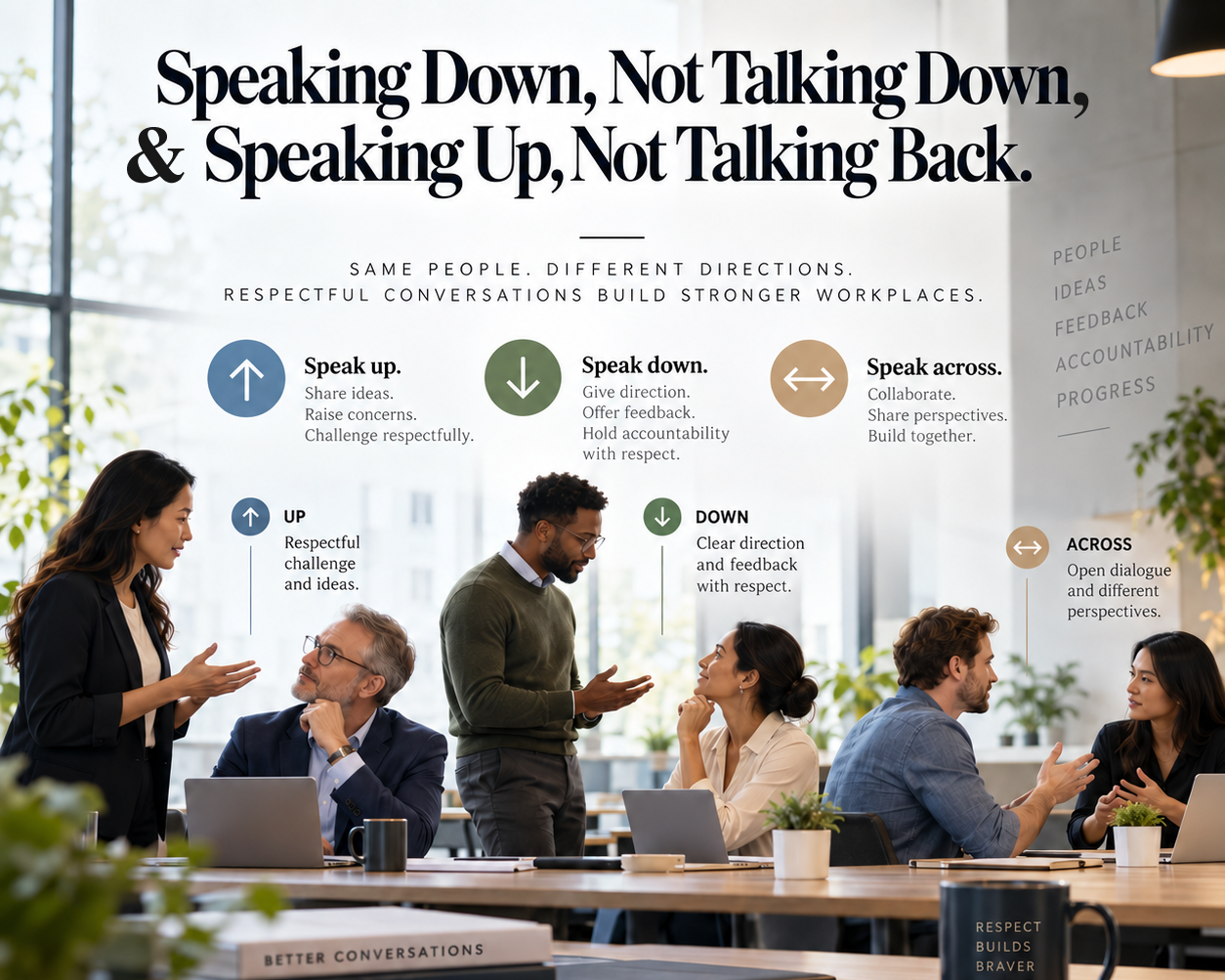
Speak up. Speak down. Speak across.
And if one of us mucks up, don’t worry, this is where SpatzAI comes in: if one of us talks down, talks back, or otherwise crosses an agreed behavioural line, that we would have already agreed to beforehand, then the other person has the right to course-correct, using the agreed Spatz procedure, regardless of position, status, or direction.
Because, we believe the issue was never simply who gets to speak.
It is how we have agreed to speak to each other.
Speak well, grasshopper, and be willing to be course-corrected when we don’t get it quite right.


Leave a comment