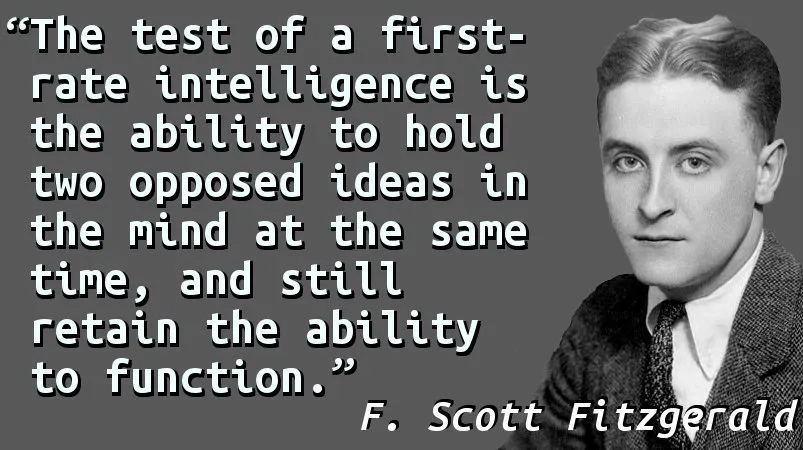
“The test of a first rate intelligence is the ability to hold two opposed ideas in the mind at the same time, and still retain the ability to function.”
F. Scott Fitzgerald
I believe “The test of a first-rate intelligent team is the ability to hold two opposed ideas in their minds at the same time and continue to thrive cohesively.”
Psychological safety AND accountability are often treated as competing ideas. I think they become easier to understand when we separate the problems that, I believe, they are designed to address.
Psychological safety is needed to help people bring forward unintended mistakes. It allows someone to say, “I got this wrong,” “I need help,” or “I am unsure,” without fearing humiliation or punishment. Because mistakes are usually unintended, the appropriate response is to learn what caused them and how they can be prevented or corrected.
This is broadly the problem Amy Edmondson’s research on psychological safety was designed to address: creating conditions in which team members feel able to admit errors, ask for help, express uncertainty, raise concerns, and contribute to collective learning.
However, I believe her research fails to adequately address misbehaviour.
Misbehaviour creates a different problem. It involves conduct that may breach an agreed behavioural standard and therefore requires accountability. Accountability does not necessarily mean punishment. It means the behaviour is clarified, classified, acknowledged, and corrected proportionately.
This is where intention matters. A mistake is usually unintended. Misbehaviour is usually intentional behaviour, although the person may dispute its meaning, fairness, or effect. Until that is resolved, it is disputed behaviour awaiting classification.
- Psychological safety helps reveal and address unintended mistakes.
- Accountability classifies disputed behaviour and addresses misbehaviour proportionately.
SpatzAI utilises both psychological safety and accountability to help team members identify and clarify conduct, determine whether it constitutes misbehaviour, and address confirmed misbehaviour proportionately.
When misbehaviour is addressed early, the required accountability should be minimal:
- An acknowledgment when cautioned,
- A simple apology if challenged, or
- An acceptable apology if a team & AI review is required.
None of these outcomes is inherently punitive. They are disciplinary in the corrective sense: they bring behaviour back into alignment with an agreed standard.
Punishment imposes suffering or penalty. Accountability requires acknowledgment and repair.
The practical goal is not to make people pay for misbehaviour, any more than they should pay for an honest mistake. It is to address it early enough that acknowledgment, apology, and correction are all that is required.
 Object123
Leave a comment