Most organizations already measure productivity, delivery speed, incident rates, and customer satisfaction. Very few measure how efficiently their teams resolve the everyday micro-conflicts that quietly affect all of those outcomes.
SpatzAI proposes that team micro-conflict resolution can be measured similarly to quality control, operational flow, or incident response systems.
The core idea is simple:
The earlier a team resolves a behavioural issue, the lower the organizational cost.
The longer a spat remains unresolved, the more friction accumulates across communication, trust, morale, creativity, and decision-making.
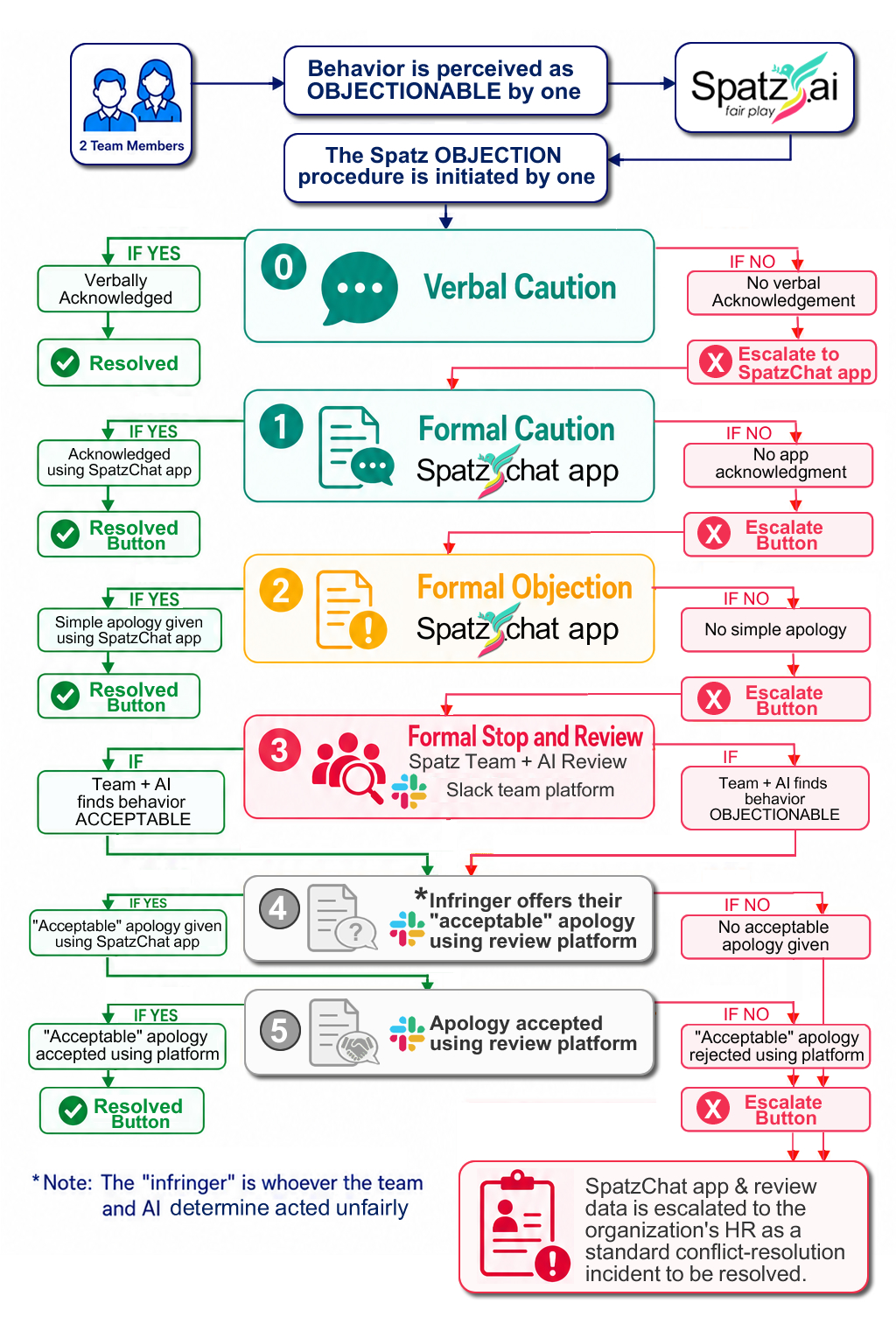
The SpatzChat™ procedure measures this through a staged escalation process:
| Step | Resolution Stage |
|---|---|
| 0 | Verbal Caution |
| 1 | Formal Caution |
| 2 | Formal Objection |
| 3 | Formal Stop & Review |
| 4 | Acceptable Apology |
| 5 | Apology Accepted |
Each stage represents increasing organizational effort and social repair cost.
A team that consistently resolves issues at Step 0 or Step 1 is likely operating with strong accountability, responsiveness, and psychological protections.
A team regularly escalating to Step 3 or HR may be experiencing deeper behavioural friction, avoidance patterns, or breakdowns in trust.
SpatzAI can measure:
- Average time to resolution
- Escalation rates between stages
- Acknowledgment response times
- Apology acceptance rates
- Repeat behavioural patterns
- Overall team friction load
The system can also apply weighted escalation scoring.
For example:
This creates a measurable “Team Conflict Resolution Efficiency” profile.
| Highest Stage Reached | Relative Cost |
|---|---|
| Step 0 | Very Low |
| Step 1 | Low |
| Step 2 | Moderate |
| Step 3 | High |
| HR Escalation | Very High |
Over time, patterns begin to emerge.
Teams that resolve issues early may:
- collaborate more openly,
- maintain healthier disagreement,
- reduce management intervention,
- and recover faster after tension.
Teams that resolve issues early may:
- collaborate more openly,
- maintain healthier disagreement,
- reduce management intervention,
- and recover faster after tension.
Teams that delay acknowledgment or avoid repair may accumulate unresolved friction that eventually impacts performance, retention, and culture.
In this sense, SpatzAI is not merely a conflict resolution tool.
It is an early warning and behavioural systems analytics platform for modern teamwork.
Using the structured SpatzChat™ process together with the Team + AI Review platform, organizations can begin collating real-world behavioural interaction data at the exact moment tension becomes visible.
Over time, this allows SpatzAI to learn from patterns across thousands or potentially millions of workplace interactions.
The AI may eventually identify:
- which behaviours most commonly trigger escalation,
- which intervention styles lead to faster repair,
- which teams resolve tension most effectively,
- and which patterns correlate with innovation, burnout, disengagement, or declining performance.
In this sense, SpatzAI is attempting to create a continuously learning behavioural feedback system for teams.
Much like manufacturing systems monitor defects early in the assembly line, SpatzAI aims to help teams identify and resolve behavioural friction before it becomes organizational damage.


Leave a comment