Firstly let’s define both:
Psychological safety, as defined in organisational research, is a climate where individuals can express ideas, questions, concerns or mistakes without fear of humiliation or retaliation.
Accountability is the reciprocal system of employees and managers taking responsibility for decisions, behaviors and the standards governing both.
When either concept is only implemented implicitly, gaps emerge in practice. Psychological safety that lacks explicit behavioural accountability often relies on social contracts, usually regulated by a leader’s conduct. These implicit contracts can be efficient when all participants already share norms, and the manager is disciplined. However, they become fragile when norms diverge or when an individual or manager crosses someone’s boundary.
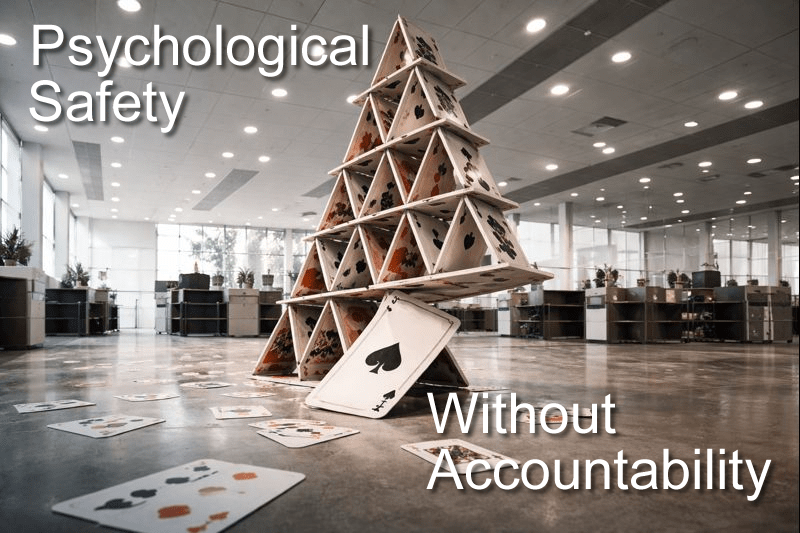
In other words, psychological safety, without accountability, is like a house of cards and is prone to collapse, especially when misbehavior occurs. Wikipedia: Psychological safety versus accountability
A common failure symptom occurs early: the first unmoderated boundary breach. When a person unfairly uses dismissive language, shuts down a suggestion, personalises a critique, or asserts dogmatically, “I am right, you are wrong”, citing a behavioral norm as if it were universal law, the environment shifts. The issue is not the content of the idea being challenged, but the absence of a shared protocol to moderate the challenge itself. Without an agreed escalation path for behavioral correction, participants default to self-protection strategies: defensiveness, withdrawal, silence, or premature harmony -“let’s agree to disagree”. These reactions are predictable not because people are flawed, but because the system gave them no disciplined alternative to address any unfairness.
Individual accountability is a skill because it can be learned, standardised and operationalised. It requires agreeing to be fairly course-corrected and a tolerance for the possibility of being wrong, without assuming punitive consequences are the intent. Alternatively, managers who only treat accountability as retrospective reporting or managerial enforcement often miss the 80–90% of micro-level frictions that never qualify as formal incidents, yet still shape the culture at the core during collaboration.
I believe that an effective accountability system like SpatzAI, introduces proportional steps:
- 0. A lightweight Verbal Caution and Acknowledgement for minor or one-off boundary breaches.
- 1. A more Formal Caution and Acknowledgement using a bespoke chat app, if the verbal caution is challenged or ignored.
- 2. A Simple Apology when unresolved and escalated to a Formal Objection.
- 3. An Acceptable Apology for when escalated to a Formal Stop,
with a team and AI review for when the issue cannot be resolved.
SpatzAI positions accountability as a service layer rather than a surveillance tool. It embeds a normalised Caution → Objection → Stop escalation model directly into a bespoke messaging app and routes unresolved stops into a protected team and AI review process using existing team platforms. I believe that accountability systems, like SpatzAI, designed well, can create clarity of boundaries, parity of objection rights, and a data-rich feedback loop that strengthens collaboration after the first breach rather than allowing it to collapse like a house of cards.

References:
Limits of psychological safety alone – Research finds that high levels of psychological safety can actually harm performance on routine tasks when collective accountability is low, and that accountability moderates this effect. In studies across different settings, psychological safety without accountability was associated with decreasing performance outcomes, but when accountability was high, this negative relationship was buffered.
Dual necessity of psychological safety and accountability – A qualitative academic study of workplace experiences shows that high psychological safety combined with high accountability produces optimized learning and performance, while low accountability reduces effectiveness even when psychological safety is present.
 Object123
Leave a comment