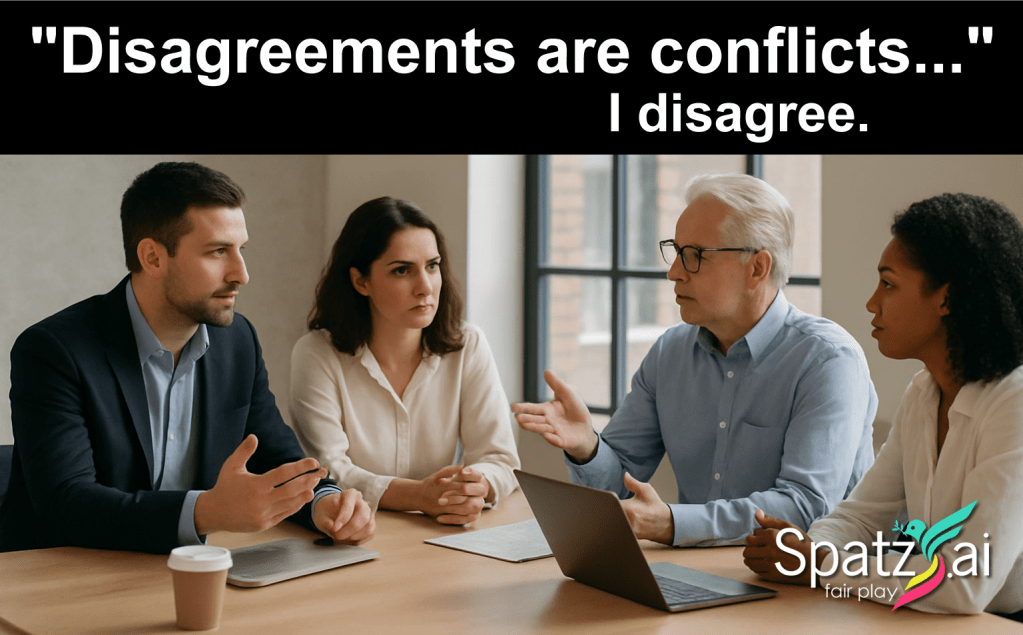
I often question why we lean on the word conflict for what is, at its healthier core, simply disagreeing.
Those terms are frequently used interchangeably by experts (Amy Gallo, LinkedIn Post), HR frameworks, and even AI labels, yet they describe different events, carry different temperatures, and call for different tools.
A disagreement is a clash of ideas or opinions without necessarily sliding into hurt, breach, or retaliation.
Teams can disagree fiercely, even passionately, while still sitting around the same table, still playing fair, still moving forward.
That kind of tension is generative, collaborative, and safe when no one’s tone or behaviour crosses a moral or interpersonal line.
By contrast, a micro-conflict begins with a small behavioural infringement.
A tone shift, an eye roll, an interruption, a dismissed interest, or absolute language that threatens someone’s space.
It’s the sort of moment where the debate is no longer about the ideas being exchanged but how they’re being delivered, and how one or both sides react in return.
The spark is behavioural, not intellectual. Tit-for-tat sets in. The spat owns the room, not the problem.
When organisations label idea clashes as “conflict” by default, culture and wellbeing become outsourced upward to managers, psychology models, or HR mediation layers.
Friction becomes a case file, not conversation.
Ownership shifts from the team to a role or a department.
We medicalise what is often a deeply normal human process: diverging views, converging on better answers.
Language changes how we name severity, choose tools and design escalation paths.
In my view we should normalise disagreeing on ideas, and separately recognise behavioral conflict or micro-conflicts only when tone or actions breach a boundary and require structured resolution or review.
And for this resolution and review of infringements that initially cause our micro-conflicts, we propose using a systems intervention like SpatzAI. This allows teams to address behavior directly in real-time, escalate proportionately, and close issues through collective review, when needed, turning friction into structured insights without confusion.
 Object123
Leave a comment