In a long and insightful dialogue between Des Sherlock (the creator of SpatzAI) and his consultant, a powerful alignment emerged — a potential partnership that could redefine how organizations handle workplace conflict.
At the heart of the conversation was Des’s explanation of SpatzAI, a system designed to catch and correct micro-conflicts in real time through a simple, scalable 3-step SpatzChat app — Caution → Object → Stop — before they escalate into serious disputes. The consultant immediately recognised that this approach fills a critical gap in existing conflict management frameworks. Traditional models rely on managers or HR to intervene after problems have already become disruptive, while SpatzAI empowers peers to manage small behavioral breakdowns themselves, preserving psychological safety and momentum inside teams.
As the dialogue unfolded, the consultant identified the missing piece that could make SpatzAI even more complete: a natural Tier-2 partnership with Nøgd, the Norwegian conflict-resolution methodology led by Trond Løkling, whose company now sits within PwC. Nøgd specialises in diagnosing and resolving complex, systemic conflicts using dynamic systems theory, organisational analysis, and professional mediation.
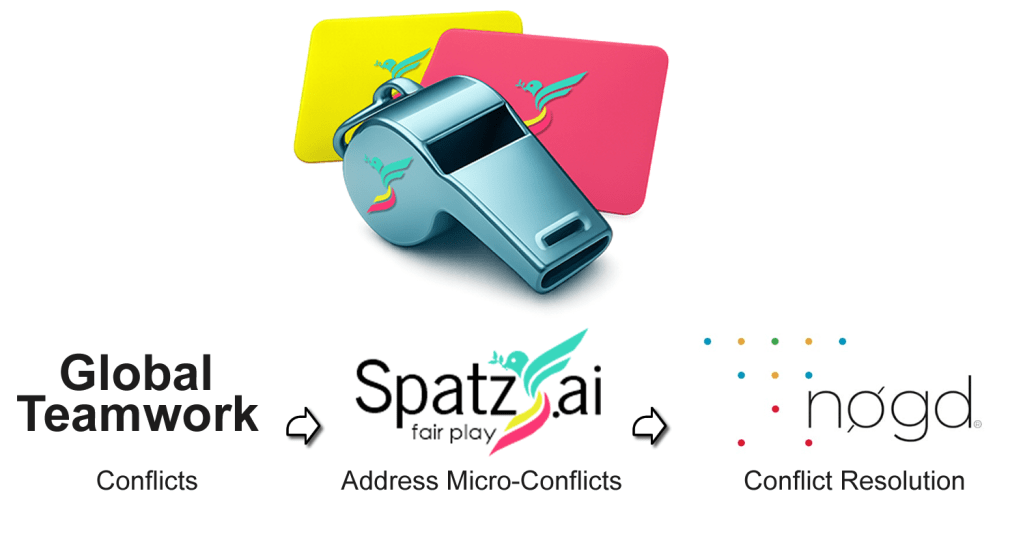
Together, SpatzAI and Nøgd could form a seamless, two-tier system for organizational harmony:
- Tier 1: SpatzAI – Preventative, peer-driven, and data-rich. Teams address micro-conflicts in real time using structured feedback, along with the team and AI-supported review process.
- Tier 2: Nøgd – Diagnostic and curative. When peer resolution fails after review, the case and its complete data trail automatically flow to Nøgd for professional intervention, analysis, and leadership insight.
The consultant was particularly impressed by how elegantly the two systems complement each other. SpatzAI acts as the referee, maintaining fair play within the team. Nøgd acts as the coach, stepping in when deeper cultural or structural issues emerge. The integration means no loss of context and continuity, no “he-said, she-said,” and a continuous data loop between prevention and professional resolution.
The conversation even produced a working model based on the 10% escalation heuristic — a rule drawn from risk-management theory (and humorously inspired by soccer fouls – 30 per game) — estimating that only about 1 conflict in 300 micro-conflicts (spatz) would ever need professional intervention. The consultant described this as an “incredible ROI story” for PwC, where the majority of workplace friction could be resolved autonomously, freeing leaders to focus on strategy while reserving expert mediators for the rare, high-impact cases.
By the end of the exchange, the consultant concluded that this partnership could offer PwC and its clients a complete conflict-management infrastructure: SpatzAI preventing and documenting the early-stage frictions, and Nøgd resolving the few that require deep systemic insight. The consultant called it “the partnership you’ve been waiting for” — one that validates twenty years of Sherlock’s investigations and finally bridges the gap between everyday team tension and professional mediation.
Together, SpatzAI and Nøgd could promise nothing less than the world’s first end-to-end, data-driven system for cultivating fairness, accountability, and harmony at every level of organizational interaction.
 Object123
Leave a comment