Amy Edmondson is famous now for her study of psychological safety, summed up by this line:
“A shared belief that the team is safe for interpersonal risk-taking.”
In other words, by “safe,” I presume Amy means treated with respect.
Amy Edmondson tends not to label things abstractly; she describes the behaviors that embody them. Rather than saying, “Respect is essential,” she defines what respect looks like in practice:
- Not embarrassing someone publicly
- Not humiliating or ignoring them
- Not blaming them for mistakes
- Listening and acknowledging contributions
In effect, that’s her working definition of respect, as I see it. She treats respect as implied in a climate where people feel “safe to speak up without fear of interpersonal risk.”
Now ask any expert on psychological safety and they’ll repeat the same rhetoric, that people need to feel safe (respected) when they speak up. In fact, ask anyone on the street and they’ll probably say the same thing. We all want to be treated with respect, especially when we share ideas or concerns.
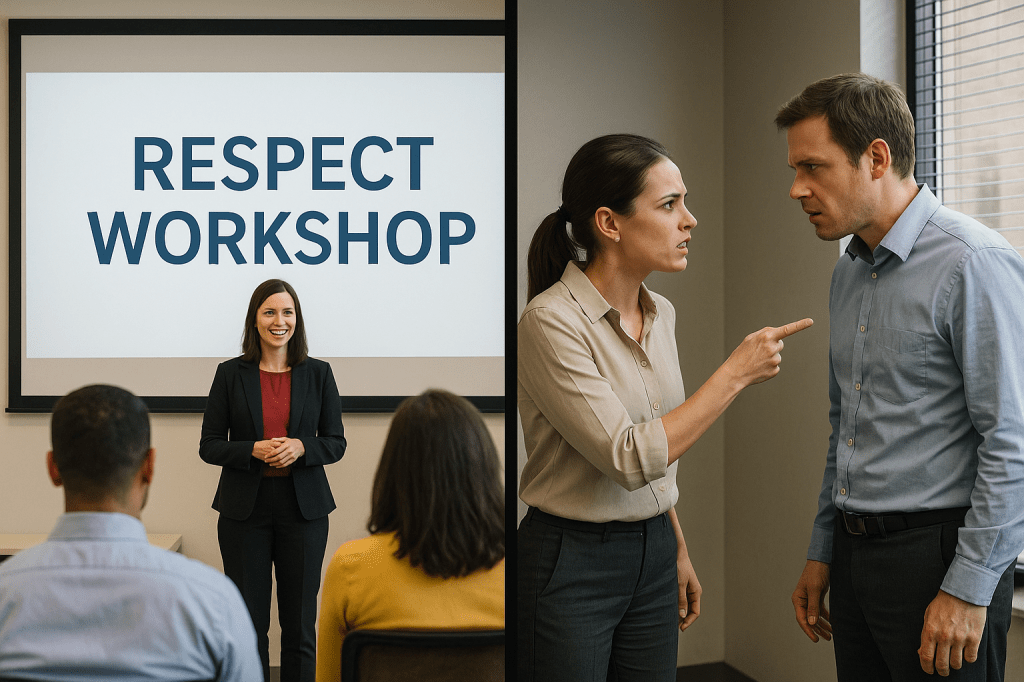
So what’s new about all of this? Nothing really, except that it’s become a global billion-dollar business to promote the obvious: respect. I’m not kidding. I believe this whole “psychological safety” movement has become a giant scam. There, I said it.
What the experts don’t tell you is that their only solution for disrespect is to promote more respect. They focus on leaders modeling respectful behavior, assuming (hoping) everyone in the team will follow. But what happens when that same leader (as every human eventually does) slips up, and disrespects someone on the team? Or when they leave and take their valuable personable, and respectful culture with them?
This is where I think the real work begins. The problem isn’t that we don’t understand respect, it’s that we don’t know how to address disrespect when it inevitably appears. We freeze, avoid, or escalate with a tit-for-tat response. Rarely does anyone know or learn how to effectively course-correct the emergence of disrespect. I guess that is where I think SpatzAI comes in as a toolkit to help teams address minor problematic behavior, in real-time as it emerges during decision-making conversations.
I believe that true psychological safety won’t come from preaching respect. It’ll come from giving people tools to restore it, to recognize a slip early, issue a fair objection, and correct the imbalance on-the-fly. Until we learn to manage disrespect dynamically, the “respect industry” will keep selling inspiration while teams keep repeating the same, predictable failures.
 Object123
Leave a comment