
Protecting people for speaking up is hardly new:
Free speech in the U.S. Constitution: Adopted as the first amendment in 1791, protects citizens from government censorship. It guarantees they can criticize, question, and express ideas without fear of legal punishment. It’s a hard legal right, enforceable in court.
Psychological safety: Has been talked about since the 1965 by Schein and Bennis, which included “an atmosphere where one can take chances (which experimentalism implies) without fear and with sufficient protection.” in its definition and later popularized (and diluted in my opinion) by Amy Edmondson.
Psychological safety could be described as “free speech lite.” It’s not legally enforceable, but, in principle it aims to protect team members within organizations. The idea is that anyone should feel safe enough to speak up, ask questions, admit mistakes or misbehavior, or challenge other’s ideas or behavior without fear of ridicule or retaliation.
Here’s the problem: saying “we have psychological safety” doesn’t stop people from laughing at a suggestion, retaliating against fair criticism, unfairly excluding a colleague, or quietly punishing someone who speaks up. It’s a promise without teeth.
What is needed to protect team members isn’t just the atmosphere of safety but the ability of any individual to act and actually be protected when they do so.
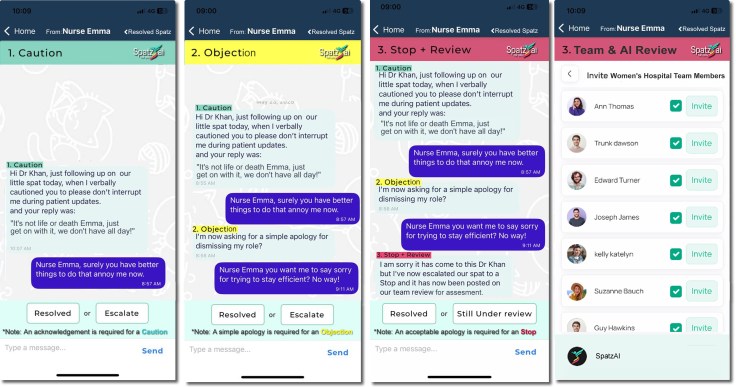
That’s where accountability systems matter. Instead of leaving safety up to culture or leadership, mechanisms like holding offending team members to account, similar to the SpatzAI model, give every person in the team a portable shield. By using the following, teams have a process to back them up:
- 0. Verbal Caution: informal pause to flag and challenge the small slip ups.
– Accountability required: A simple verbal acknowledgement.
Or, if unresolved…at a time convenient for both, the offended team member can use: - 1. Caution – SpatzChat App: formal spat escalated and document.
– Accountability required: Acknowledgement using the the chat app.
Or if unresolved… - 2. Objection – SpatzChat App: formal dispute escalated and document.
– Accountability required: A simple apology using the the chat app.
Or if unresolved… - 3. Stop – SpatzChat App & Review Platform: formal conflict, formally calling for the transparent team and AI review.
– Accountability required: An acceptable apology posted on the team review platform.
And if unresolved it proceeds to HR or management.
The key difference is this: with Spatz-style safety, protection is portable. Any individual can step up at any moment when they perceive a threat, and the system ensures their act of stepping up will be fairly protected.
So while free speech is about protecting voices in society, and psychological safety is about protecting voices in teams, neither works without the act of accountability such as acknowledging or apologizing for one’s misbehavior in response.
Real and fair protections come when individuals are empowered to object to objectionable behavior, and when their objection activates a team member’s accountability.
 Object123
Leave a comment