
In my view, Goals, Strategies, and even Tactics are great, but without Actions they’re just empty words carried away on the wind.
Take the goal of getting team members to speak up and share radical ideas, paired with the strategy of creating a psychologically safe environment. Add the tactic of encouraging fairness, accountability, vulnerability, transparency, civility, and respectfulness.
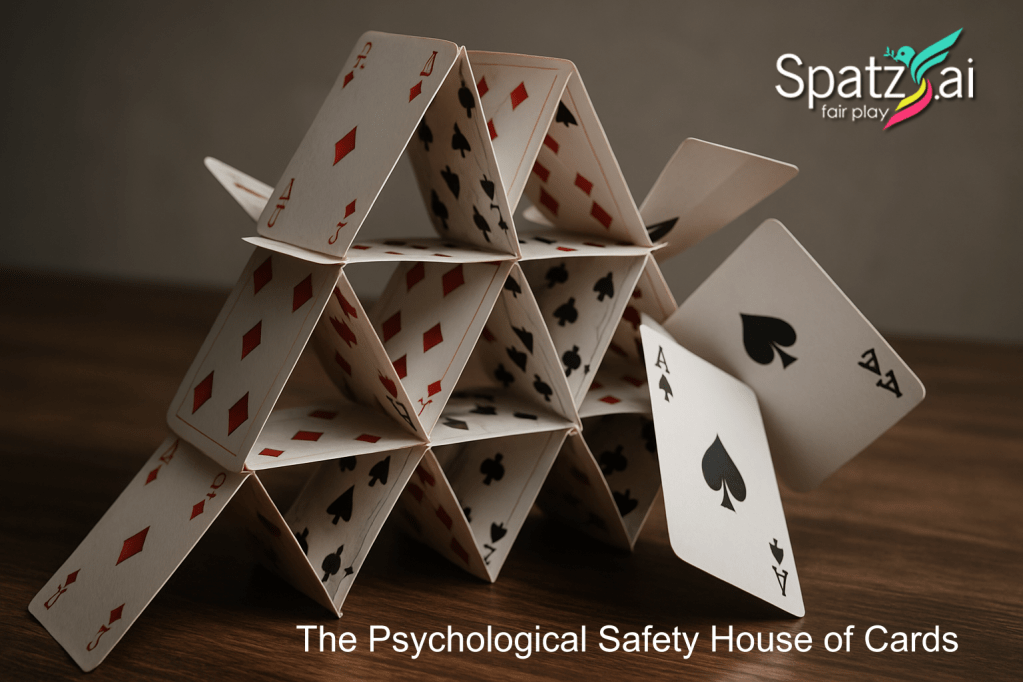
Sounds good, right? Until we hit the final step: action. What do we actually do to activate these tactics? And what do we do when they’re ignored, missing, or just not lived out? Without the foundation of clear, repeatable actions, the whole structure collapses like a house of cards. In my view, it becomes just the appearance of a plan.
Here’s the ladder I use to cut through the noise and make psychological safety real:
- Goal → The big “what we want” (e.g., teams share bold ideas freely)
- Strategy → The enabling condition (e.g., build psychological safety)
- Tactic → The chosen method (e.g., encourage fairness, accountability, transparency, vulnerability, civility, respect)
- Action → The concrete steps to activate tactics and respond when they fail (e.g., use a scalable system like SpatzAI to address unfair responses, in real time to shared bold ideas.)
Most conversations about psychological safety never reach this action layer. Instead, they frame the goal, strategy, and tactics around the leader’s action of modeling the right behaviors, hoping their example will inspire the team. But safety built only on individual behavior is fragile. It doesn’t scale, and it remains vulnerable to the inconsistencies of being human.
And that’s the problem. Until we ground our tactics in scalable actions, something teams can consistently do in the moment, we’ll be left with well-meaning slogans, clichés, and platitudes instead of workable solutions.
In other words: actions are the foundation. Without them, goals, strategies, and tactics are just scaffolding with nothing to hold them up, just like a house of cards.
 Object123
Leave a comment