
We tend to classify anger as an emotion, alongside happiness, sadness, fear and surprise.
But I think we may be conflating two different responses.
Consider the language.
We regularly say someone is “getting angry.” Strangely, we rarely talk about someone “getting happy.”
Why?
Perhaps because anger, particularly in workplace relationships, is often better understood as a process rather than simply an involuntary feeling.
A colleague says or does something in a questionable way.
Context → initial feeling → appraisal → escalation or regulation → behaviour.
I might initially feel annoyed, peeved, frustrated, offended or disgruntled. I didn’t necessarily choose that initial feeling. It occurred in response to something within a particular context.
But what happens next?
I can clarify.
I can gossip or vent later.
I can ignore.
I can put my foot down and say, “Caution, that’s not acceptable to me.”
Or I can get angry.
And we generally know what “getting angry” can entail: changes in tone, increased volume, aggressive language, accusations, hostility and, at higher levels, abusive or threatening behaviour.
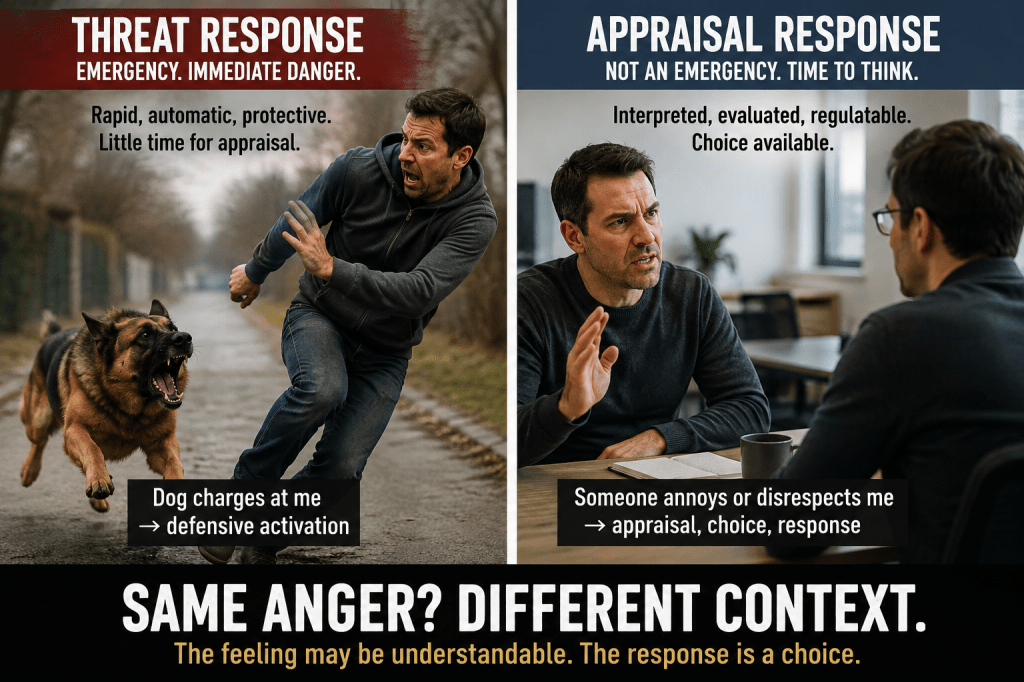
This is importantly different from what is called the emergency or threat response.
If a dog suddenly charges at me, rapid defensive arousal may occur before I have much opportunity for reflective appraisal. In that context, an anger-like response may be completely understandable and justified.
But most anger occurring in everyday workplace relationships isn’t caused by a dog chasing us.
So, in context, anger can arise through an appraisal-mediated response or as part of a rapid emergency threat-response.
Someone annoyed us. Disrespected us. Ignored us. Disagreed with us. Failed to meet an expectation.
The initial feeling may be understandable.
But if non-angry alternatives are available, choosing to escalate that feeling into anger becomes much harder to justify.
Perhaps, once again, (see: Let’s Stop Conflating Disagreement with Conflict) the problem is the conflation of these two responses.
And perhaps the solution to addressing and resolving anger is surprisingly simple:
It’s the context, stupid.


Leave a Reply