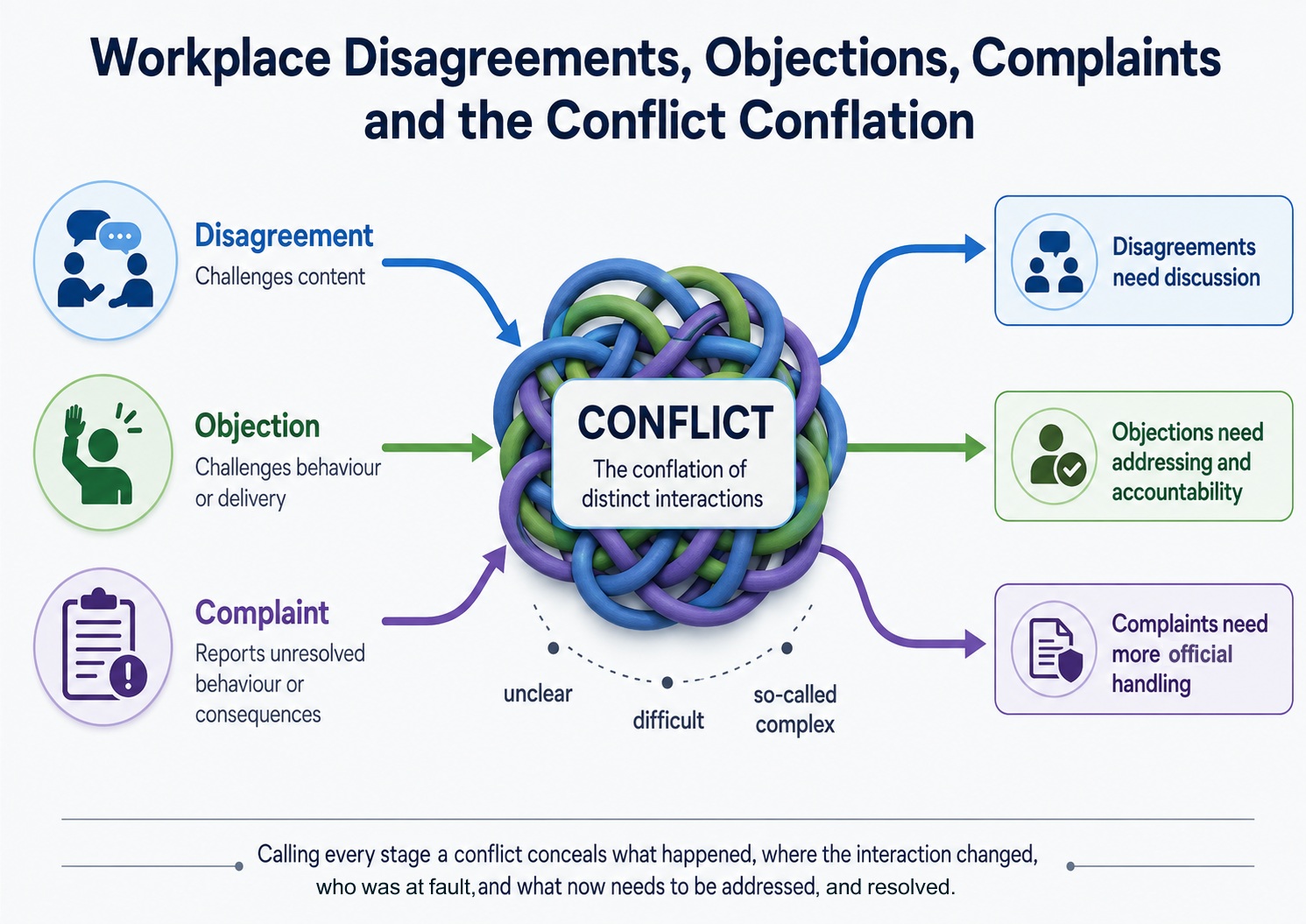
Workplace disagreement, objection, and complaint are three distinct, open or unresolved interactions. Yet they are often conflated under the broad label of “workplace conflict“.
We think this conflation makes ordinary disagreement feel dangerous, makes the person disagreeing appear difficult, leaves minor concerns about behaviour too complicated to address, and makes people hesitant to complain until serious damage has been done.
We think it’s worth noting that these three workplace interactions serve different functions:
- Disagreeing challenges the content of an interaction.
- Objecting challenges the behaviour or delivery of an interaction, usually directly and in real time.
- Complaining reports unresolved behaviour of an interaction, usually later, less direct and more officially.
The conflating of these three distinct, unresolved interactions into one tight definition called “conflict”, only complicates workplace interaction we believe.
A disagreement usually concerns an idea, interpretation, judgement, decision, or line of reasoning.
“I don’t agree that this approach will work because…”
That is not conflict or even friction. It is intellectual tension: a difference in thinking that should be addressed through discussion, evidence, questioning, and reasoning.
An objection raises a concern about behaviour or delivery.
“I object to the way you just spoke to me.”
An objection is:
- raised during or soon after the behaviour in question;
- focused on a specific interaction;
- intended to seek accountability through acknowledgement, apology, clarification, correction, or resolution; and
- managed proportionately through the SpatzAI process.
At this stage, the behaviour has not necessarily been established as misbehaviour. It has been challenged and requires clarification, acknowledgement, or review.
A complaint comes later. It reports unresolved behaviour, harm, consequences, or a repeated pattern. It is more for when an objection is unsuccessful and eventtually may also concern conduct too serious for the team process.
This creates a clear division:
A process needed to handle objections (we prefer SpatzAI).
and if still unresolved…
HR or management handles complaints.
Within the SpatzAI framework, a micro-conflict begins when one team member cautiously objects to another team member’s behaviour (usually during a disagreement) and their objection is challenged rather than acknowledged, clarified.
The sequence is:
Behaviour is cautioned → the caution is resisted → the interaction follows the Spatz process.
The disagreement did not actually create the conflict. The unresolved response to the objection did.
The problem with the conventional “conflict” framework is that every stage can receive the same label:
Someone disagrees — conflict.
Someone challenges the behaviour — conflict.
The other person resists the objection — conflict.
Someone later complains — conflict.
The interaction remains unresolved — conflict.
“What the hell is going on?”
Was this a disagreement about content, a challenge to behaviour, resistance to accountability, or an unresolved complaint? Who knows?
Calling every stage “conflict” does not clarify the interaction. It conceals what actually happened, where the conversation or interaction changed, and what, or who, now needs to be addressed.
The SpatzAI process provides a proportionate pathway from verbal caution to formal caution, formal objection, stop, and Team and AI Review. If the matter remains unresolved, it can then proceed to HR as a complaint.
The aim is not to redefine every disagreement as conflict. It is to stop disagreement, objection, complaint, and conflict from being treated as interchangeable.
Disagreements need discussion.
Objections need addressing and accountability.
Complaints need more official handling.
Conflicts need to be parsed into their component interactions, with each addressed accordingly.
When these distinctions are clear and agreed upon, people can disagree confidently, object before behaviour escalates, and finally reserve official complaints for unresolved matters that genuinely require managerial or HR intervention.
 Object123
Leave a comment