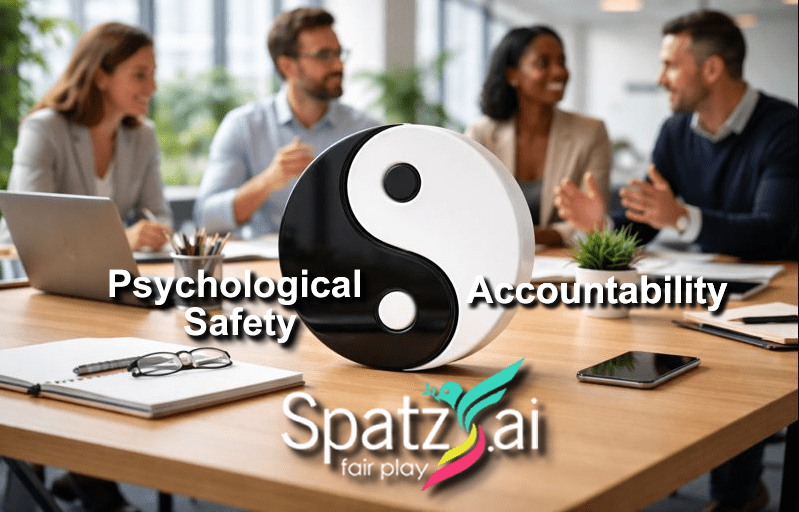
I believe that accountability is the principle that separates leadership from governing behavior and ultimately makes it more credible. It is the counterbalance to psychological safety, the yang if safety is the yin. Psychological safety protects and encourages people to speak up. Accountability protects the standard at which speaking up occurs. Together, they make fairness more tangible, in my view.
Without psychological safety, bullying and silence can dominate, and issues stay hidden. Without accountability, expression can drift into coercion, dogma, blame, or rhetorical pressure. The result is not fairness but imbalance, where the loudest or most confident voice shapes outcomes rather than the most reasonable one.
This is where I believe accountability must come before authority. Authority grants permission to decide. Accountability creates the obligation to answer for how one behaves while deciding. When accountability is weak, authority tends to harden into control. When accountability is strong, authority becomes serviceable and restrained. This is the rationale behind checks and balances.
SpatzAI is designed as an accountability intervention at the exact moment people begin to speak up. It does not silence expression or route concerns away from the team. Instead, it introduces a shared, agreed procedure for course-correcting, enabling team members to object to objectionable language and behavior in real-time, anchored to observable actions rather than personal labels.
By pairing permission to speak with responsibility for delivery, SpatzAI helps teams preserve psychological safety without sacrificing standards. Speaking up remains protected, but it is no longer consequence-free. The combination shifts teams away from power dynamics and toward fair process, where behavior is addressed early, proportionately, and transparently, rather than punitively.
 Object123
Leave a comment