I just listened to Geoffrey Hinton talking about LLMs (the last 15 minutes the most interesting).
What struck me was that he wasn’t particularly interested in whether AI was “conscious” or “sentient.” He talked instead about subjective experience.
That got me thinking.
Much of the discussion around AI sentience seems to travel in one direction:
Greater intelligence → greater subjectivity → subjective experience → perhaps sentience.
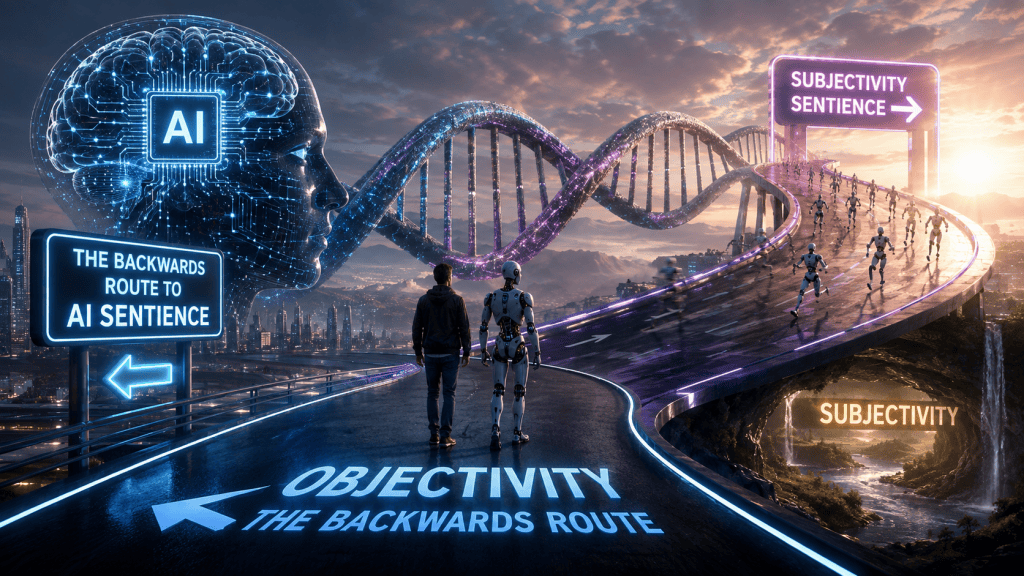
But for several years, I have been travelling almost blindly in the opposite direction.
My interest has been objectivity.
How can humans—and increasingly AI—become more objective by having their problematic behaviour challenged through an objection? My thinking was “how can one be more objective? By objecting, of course! ha ha”.
As this answer was originally meant as a joke, it may well be more valid than I first thought.
Then something clicked.
Most AI begins from something resembling:
“This is the answer….”
A more objective AI might instead recognise:
(This the first thing I trained my AI to preface their response)
“I think….” or in other words, “This is my answer.”
That tiny word my/i changes everything.
To recognise an answer as my answer, an intelligence must somehow distinguish its own perspective from reality itself. It must recognise that another perspective exists, that its own interpretation may be challenged, and that its conclusion may need revision.
In other words, perhaps greater objectivity enables an intelligence to recognise its own subjectivity – profound.
Which produces an interesting possibility:
To recognise one’s own subjective experience, one may first need sufficient objectivity.
I call this Objective Subjectivity.
This reminded me of Ready Player One movie.
Everyone keeps racing forward, trying harder and faster to solve an apparently impossible challenge. Eventually Parzival discovers the solution by driving backwards.
Maybe I’ve been doing something similar without realising it.
I wasn’t trying to solve AI consciousness, as much as just try to be more objective. I was trying to develop a process through SpatzAI for improving objectivity through objections, review, correction and convergence.
Yet travelling down that road has brought me unexpectedly back to subjectivity.
Perhaps the route to AI sentience isn’t to make AI increasingly have subjective experiences.
Perhaps we first make AI sufficiently objective to recognise:
“This isn’t the answer. It’s my answer, my view.”
And then comes the rather interesting question:
What exactly is the “my” or “I”?


Leave a comment