With a clear team agreement and a fair process for addressing misbehaviour, I believe teams can, more often than not, stop minor infringements from escalating into micro-conflicts, disputes, or larger conflict. The real issue is not just the behaviour itself, but whether there is a shared way to raise and resolve it fairly.
Without that shared process, I think one of the blind spots in how we address conflict is that we often name it too late, when it is too serious to resolve effectively, or too early, when it is still only one person overstepping the mark and the reaction itself helps drive the escalation.
If one person behaves unfairly, dismisses someone, unfairly interrupts them, or makes an unreasonable challenge, I do not think that is necessarily a conflict yet. It is more like an infringement, or a breach. Something objectionable has happened, but conflict, in my view, begins when that behaviour is observed, raised, and then resisted.
That is the important threshold, I believe.
The issue is not only the original infringement, but the way the infringement is observed and objected to also matters. Once the issue is raised, the other person may ignore it, reject it, justify it, or turn the objection back on the person raising it. At that point, the matter changes state. It is no longer just one person’s behaviour. It has become a contested interaction between two positions.
One person says a line was crossed.
The other denies it, reframes it, or reverses it.
That, I think, is where a micro-conflict, or spat, begins.
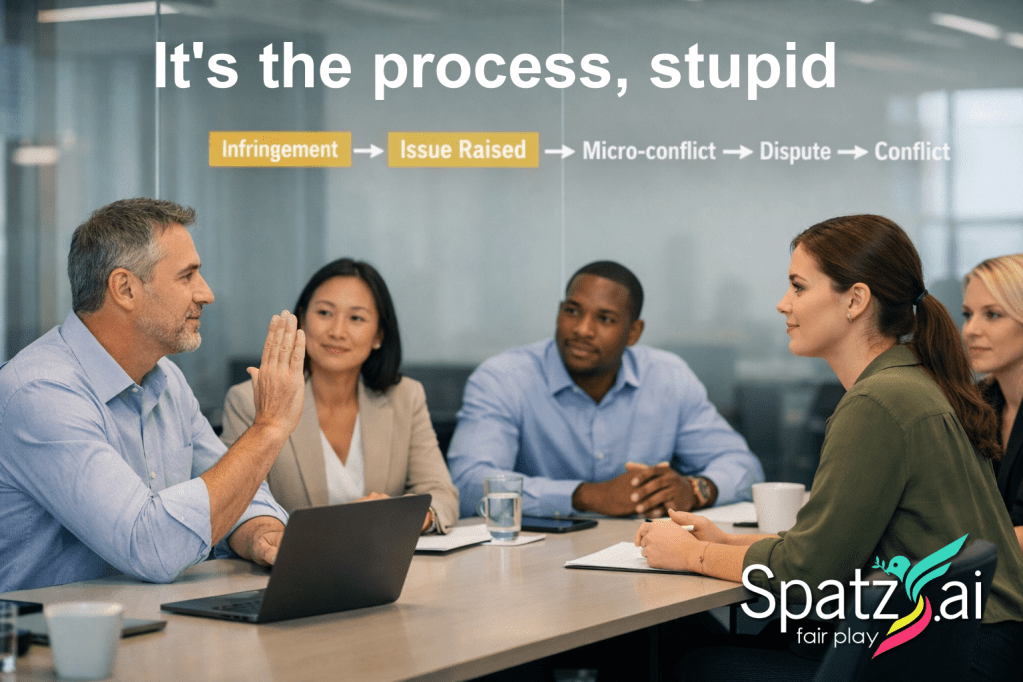
Understanding this matters because it gives us a clearer sequence:
Perceived infringement → Objection raised → Objection resisted or reversed → Micro-conflict → Dispute → Conflict
The practical value of this distinction is that it helps teams protect healthy debate while addressing objectionable behaviour earlier and more clearly. Debate, disagreement, and tension are not the problem. The problem begins when there is no agreed way to raise a behavioral issue fairly, and the raising of the issue itself becomes the entangled issue.
I believe this could be why conflict is so common in workplaces. It is not only that people overstep boundaries. It is also that many teams have no shared method for observing, naming, and objecting to those breaches without the objection itself collapsing the situation into conflict.
By creating a shared process for both objection and accountability, we reduce the chance of two infringements forming, the original one and the objection being treated as another. We do not guarantee objectivity, but we may move closer to it faster.
Ironically, the moment we agree to and use a fair process, that process becomes part of the solution
 Object123
Leave a comment