I think there is an interesting philosophical divide emerging in how we think about workplace conflict and culture.
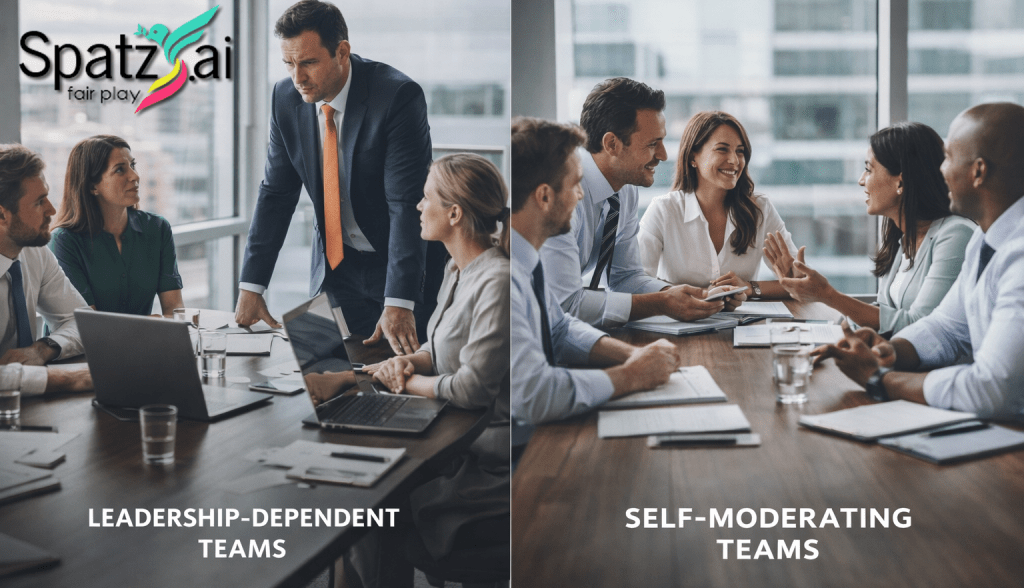
Much of the leadership literature assumes that when tension appears in a team, the leader must step in to diagnose and stabilise the situation. Credibility shifts, reputational narratives, and interpersonal tensions are treated as dynamics that leaders need to interpret and manage.
That approach is understandable. Leaders hold authority and are often seen by management conslutants as responsible for maintaining order.
It also reflects a common belief about culture: that culture is primarily shaped from the top.
But this assumption can unintentionally create structural dependency.
If every behavioural issue requires leadership intervention, the team gradually becomes less capable of resolving its own tensions. Small frictions accumulate while people wait for someone higher up to address them. Over time, leaders become referees of everyday behaviour, and the team’s culture becomes dependent on how often, and how well the leader intervenes.
Another possibility is to design systems where teams handle these behavioural dynamics themselves.
In that model, culture is not something leaders simply enforce. It emerges from how teammates respond to each other’s behaviour in real time.
This is the philosophy behind SpatzAI.
Disagreements remain disagreements, and when someone’s behaviour crosses a line during the discussion, it can be addressed quickly and proportionally by the person involved rather than escalated upward. Small issues are surfaced early, acknowledged, and resolved before they harden into reputational narratives or larger conflicts.
If the issue cannot be resolved then and there, they can use the SpatzChat app to document their spat, and if still unresolved, it gets bumped to the Spatz Team and AI Review platform.
The practical advantage of this approach is scalability.
A leader can only intervene in a limited number of situations. But if a team has a shared process for addressing behavioural issues as they arise, the system becomes largely self-moderating. Leaders are freed to focus on direction and strategy rather than mediation.
Instead of positioning leaders as referees of team behaviour, the system equips teams with a structured way to address micro-conflicts themselves, helping culture form from the base of the team rather than relying solely on the boss.
 Object123
Leave a comment