In organizational life, words matter. Yet I’ve noticed that even respected experts blur the line between disagreement and conflict. This conflation, while well-intentioned, can backfire—discouraging the very disagreements that fuel innovation.
Take Amy Gallo, a workplace expert and author of Getting Along. In her TED talk The Gift of Conflict, she says:
“Disagreeing is something most people avoid whenever possible. But staying silent can be damaging, and speaking up when you disagree can be productive, as long as it’s done with compassion and kindness.”
Amy Gallo
Here, disagreement is framed as conflict, as though the two are synonymous. Again, disagreement is equated with conflict, collapsing two distinct dynamics into one.
And similarly, in her Harvard Business Review writing, she advises leaders to:
“…normalize disagreement. Say out loud that conflict is expected.”
Amy Gallo
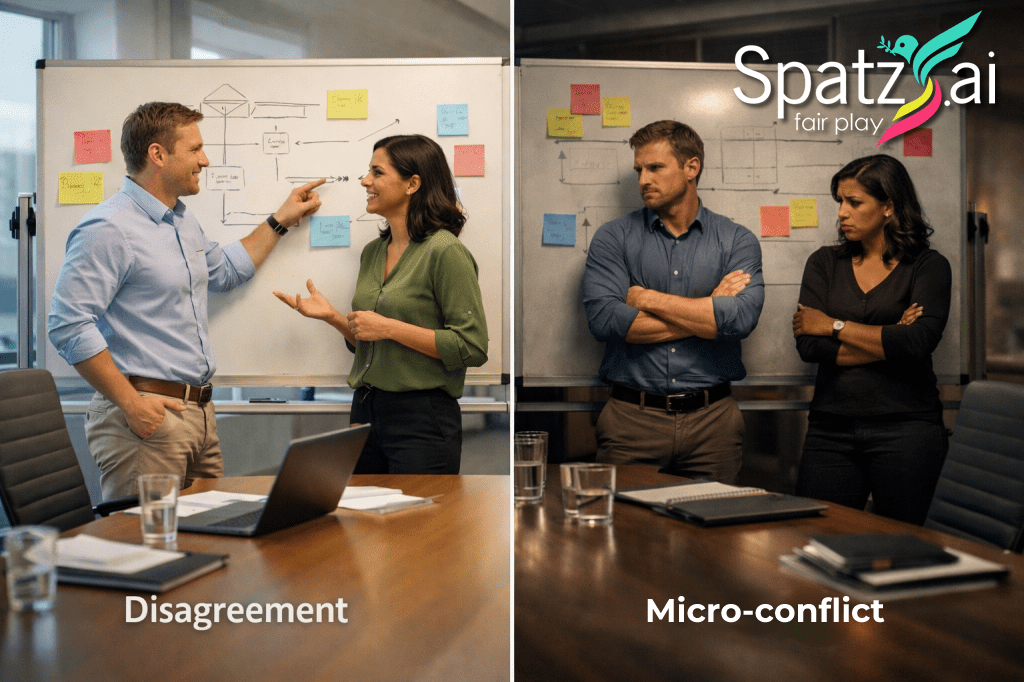
Why does this matter? Because disagreement is not conflict. Disagreement is simply divergence of thought—two people seeing things differently. Conflict arises when that divergence escalates into tension, emotion, or perceived threat.
Every conflict contains a disagreement, but not every disagreement becomes a conflict.
By conflating them, experts risk stigmatizing disagreement. If disagreement is labelled as “conflict,” then those who are conflict-averse may avoid even mild dissent. The result? False harmony, suppressed dissent, and later eventual escalation when unspoken issues resurface. Ironically, this avoidance increases the likelihood of destructive conflict.
I believe that we need more precision. Disagreement should be reclaimed as a safe and constructive act, essential for creativity, correction, and problem-solving. Through SpatzAI, I think it helps to break what many people loosely call conflict into clearer parts: micro-conflict (or spat), dispute, and finally conflict. That gives teams a more usable language for recognising what is actually happening, responding proportionately, and addressing friction before it escalates. When we separate disagreement from these stages of conflict more clearly, teams can speak up earlier, think better together, and protect collaboration without treating every difference of view as a threat.
 Object123
Leave a comment