I think this statement can undervalue teams:
I think teams often wait for leaders to “fix” culture, but culture is mostly created in the small moments that nobody wants to address. The everyday missteps. The minor frictions. The little evasions, interruptions, eye-rolls, dismissals, side chats, and quiet withdrawals that leave people guessing what is safe to say next.
If we as a team can’t address those minor issues in real time, I think we are training ourselves to tolerate uncertainty. And when uncertainty becomes normal, alignment gets expensive. People stop testing ideas. They stop challenging assumptions. They start managing impressions and assumptions (make an ASS out of U and ME).
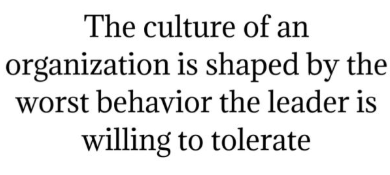
There is a popular line on LinkedIn: “The culture of an organization is shaped by the worst behavior the leader is willing to tolerate.” I think that’s partly true, but incomplete. Leaders may set the outer boundaries, but I think that the day-to-day culture is shaped by the most minor misbehavior teammates are willing to leave unaddressed.
“Worst behavior tolerated” describes the extremes. Culture damage, though, usually comes from accumulation. Small evasions, small put-downs, small power moves, small dismissals, small surprises that never get acknowledged. Each one is easy to swallow, but it becomes the norm that will choke the team.
If a team cannot address minor issues between themselves, the leader ends up dealing with major ones later: misalignment, resentment, withdrawal, politics, and the slow drift into low trust. By then, everything costs more: time, emotion, and credibility.
So the cultural question is not only “what will the leader tolerate?” It is also “what will the team address, early, while it is still cheap?”
In my opinion, a high-performing culture needs a lightweight, shared method for flagging minor misbehavior in real-time, and resetting quickly, without drama. Not reporting. Not escalation. Just a normalised way to say with a simple “Caution” that:
“I think that move was unhelpful. Can we correct it now?”
That is how minor issues stop becoming major ones.
 Object123
Leave a comment