

The Structure Behind the SpatzAI Objectivity Formula
In any team, disagreements are inevitable; left unmanaged, they can lead to micro-conflicts, unspoken tension, or inconsistent accountability, which often lead to trust breakdowns and performance drag. At SpatzAI, we’re developing a formula to help teams measure how well they respond to behavioral concerns; fairly, constructively, and in context.
Measuring Accountability Objectively: The Four-Factor SpatzAI Formula
Introduction: In most teams, conflict resolution tends to be reactive, emotional, or inconsistent.
At SpatzAI our objective is to create a system that helps teams build a more objective culture where objectionable behavior is objected to fairly, in context, and in a timely way ie real-time.
This post introduces the SpatzAI Objectivity Formula, which tracks four key aspects of micro-conflict responses:
- Was the objection valid?
- Was the objection appropriately raised and well-timed (real-time is best)?
- Did the person responsible acknowledge it appropriately?
- How long did it take for a resolution, if any?
By measuring both how concerns are raised and how they are received, we can calculate:
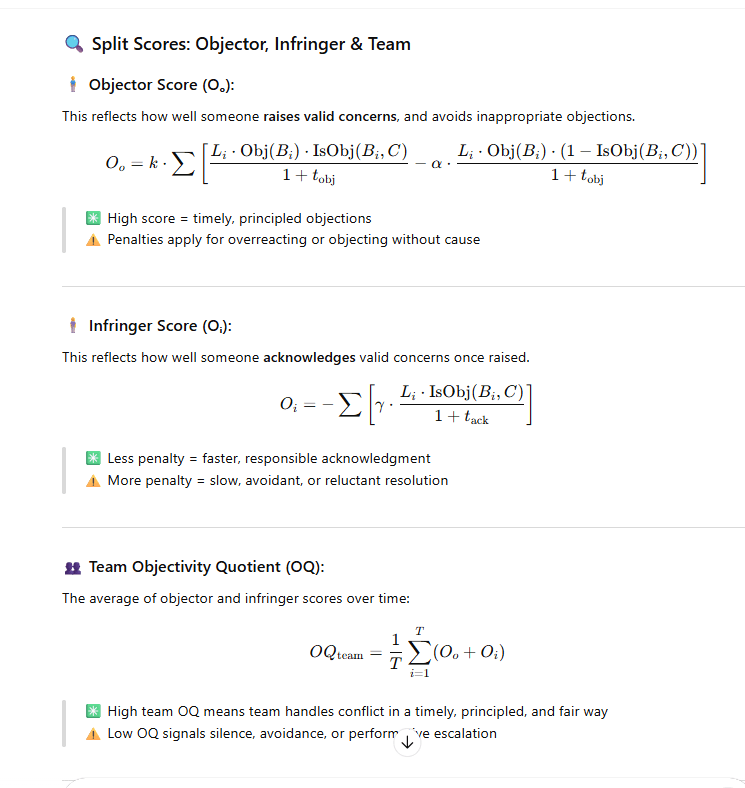
- The Objector’s Score (Oₒ)
- The Infringer’s Score (Oᵢ)
- The overall Team Objectivity Quotient (Team OQ)
This isn’t about blame or punishment, it’s about creating a transparent, principled culture where everyone is held to the same standard of accountability.
The Four Accountability Factors
| Factor | What It Tracks |
|---|---|
| ✅ Valid Objections | Was a concern raised in response to behavior that warranted it? |
| ❌ False Objections | Was something called out that wasn’t actually problematic? |
| ❌ Missed Objections | Did no one speak up when they should have? |
| ⏱️ Delayed Acknowledgment | How long did it take the infringer to take responsibility? |
The SpatzAI Objectivity Formula
Let’s start with the full formula, then explain each part.

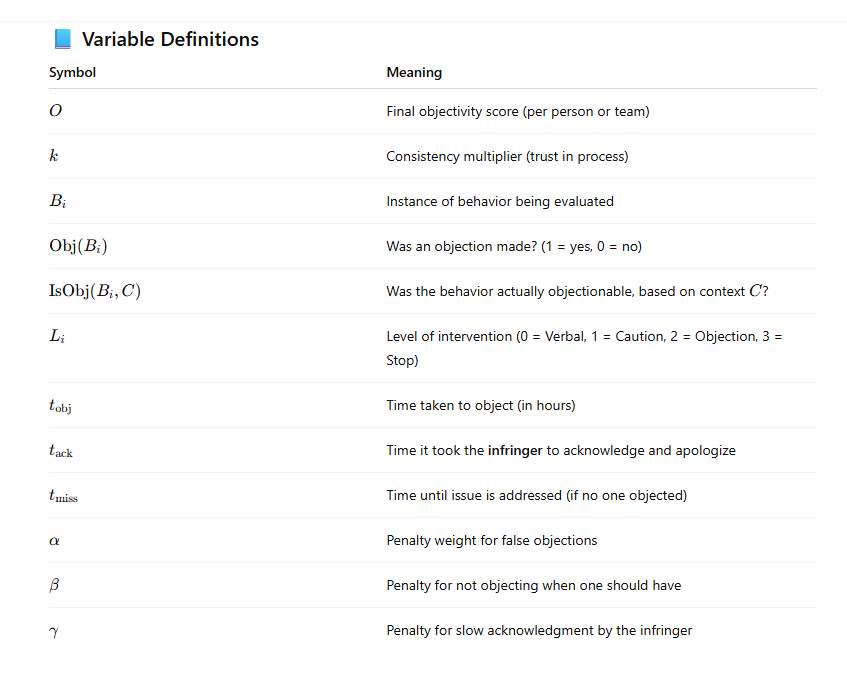
Variable Definitions
Split Scores: Objector, Infringer & Team
Real Example (Level 3 “Stop”)
Scenario 1.
- Sue violates team norms (one incident).
- Bruce raises a direct Verbal Caution (L = 0) → ignored.
- Bruce raises a direct Formal Caution (SpatzChat app) in real time (L = 1) → ignored.
- Bruce escalates to direct Formal Objection (SpatzChat app) (L = 2) → still ignored and challenged.
- Bruce escalates to direct Formal Stop (SpatzChat app) (L = 3) → posted to SpatzAI peer review platform.
- Team/peer and AI review confirms behavior was objectionable.
- Sue takes 7 days (168 hours) to give an acceptable apology.
For scoring purposes we take:
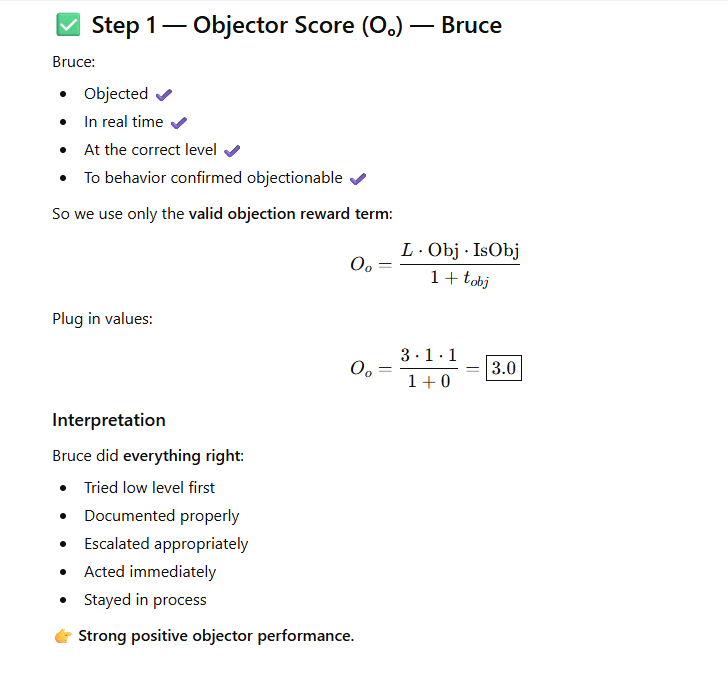
- Final effective intervention level: L = 3 (Stop)
- Time to object: tₒᵦⱼ = 0 hours (real-time escalation)
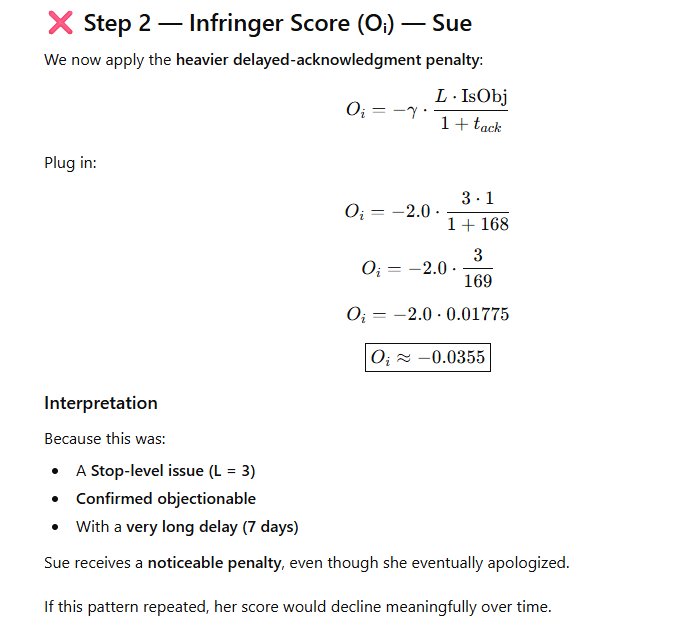
- Time to acknowledge: tₐ𝚌ₖ = 168 hours
Weighting choices (“heavier” delay penalty)
We’ll use:
- k=1 (baseline integrity)
- α=0.5 (false objection penalty — not used here)
- β=0.75 (missed objection penalty — not used here)
- New heavier delay weight:
👉 γ=2.0 (this is the stronger penalty you requested for slow apology at Stop level)
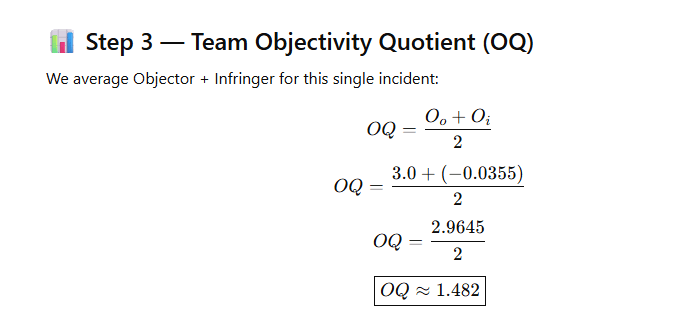
What this means in plain English
| Actor | Score | Meaning |
|---|---|---|
| Bruce (Objector) | +3.0 | Excellent procedural integrity and courage |
| Sue (Infringer) | –0.036 | Accountability was too slow for a Stop-level issue |
| Team OQ | 1.48 | Overall positive — but weakened by delayed repair |
The team is still net positive, because:
- The objection system worked
- Peer review functioned
- An apology eventually happened
But the week-long delay is now visible in the metric, which is exactly what you asked for.
We can adjust the penalty delaying an Apology
You could increase γ to:
- γ = 3.0 → Oᵢ ≈ –0.053
- γ = 5.0 → Oᵢ ≈ –0.089
We can tweak the preference to recompute the results.
Even though the objection was handled well, the delayed apology slightly lowered the team’s objectivity quotient.
Why a Team’s Objectivity Intelligence (OQ) Matters
This formula tracks not just what people feel, but how people actually engage during micro-conflicts:
- Do they speak up when it counts?
- Do they stay grounded in context?
- Do they take responsibility quickly when needed?
With the SpatzAI Objectivity Formula, teams can move from guessing at a culture’s quality to measuring it and improving it over time.
FAQs
1. On False Precision
- Question: I noted that the formula risks presenting subjective judgments (validity of objections, timeliness) as mathematically precise.
- Answer: OQ is only a quotient, a relative measure, not absolute objectivity. Just as with computer code, users don’t need to understand the math; they only need to trust its derivative and validity.
2. On Timeliness vs. Impulsivity
- Question: I suggested clarifying that “real‑time” doesn’t mean impulsive, since impulsive objections could undermine fairness.
- Answer: Impulsive objections are naturally corrected: the accused can challenge them, peer/AI review exposes invalidity, and the objector must apologize. Thus, impulsivity backfires, reinforcing principled timeliness.
3. On Gaming the System
- Question: I raised the risk of people gaming the formula (e.g., perfunctory acknowledgments or apologies).
- Answer: Gaming is acceptable at low levels (acknowledgment suffices for minor cautions), but at higher levels (Stop), accountability requires an acceptable apology. The objector has veto power, so gaming cannot erase responsibility.
4. On Usability vs. Complexity
- Question: I suggested that the math may intimidate non‑technical users, and outputs should be simplified.
- Answer: Users don’t need to understand the math — just as they don’t need to understand computer code to use software. Agreement on fairness and validity is enough for adoption.
Questions Summary:
- Relative measure: OQ is not absolute objectivity, but a quotient that organizes subjective judgments.
- Principled timeliness: Real‑time objections are essential, but impulsivity is self‑correcting in the system.
- Tiered accountability: Gaming is tolerated at low levels but blocked at high levels through apology requirements and veto power.
- Trust over math: Users don’t need to grasp the formula; they only need confidence in its fairness and consistency.
 Object123
Leave a comment