Here, I am going to say it.
I believe dogma is one of the great curses holding back human progress — in science, business, organisations, and increasingly, AI.
And ironically, I think dogma often arrives wearing the badge of expertise.
The more knowledgeable we become, the easier it is to confuse “this is what I currently believe” with “this is how things are.”
Three thinkers have strongly influenced my thinking here.
Karl Popper argued that scientific knowledge advances not by proving ourselves right, but by exposing our ideas to criticism and attempting to prove them wrong. Knowledge remains provisional.
Richard Feynman — Nobel Prize in Physics — expressed essentially the same intellectual discipline from inside science. The danger begins when we fool ourselves into believing our own explanations. Doubt isn’t science’s weakness. It is part of its machinery.
Then there was Edward de Bono, particularly his book; “I Am Right, You Are Wrong“. He challenged the adversarial tradition of thinking in which intelligence becomes associated with proving somebody else wrong rather than exploring possibilities using parallel talking.
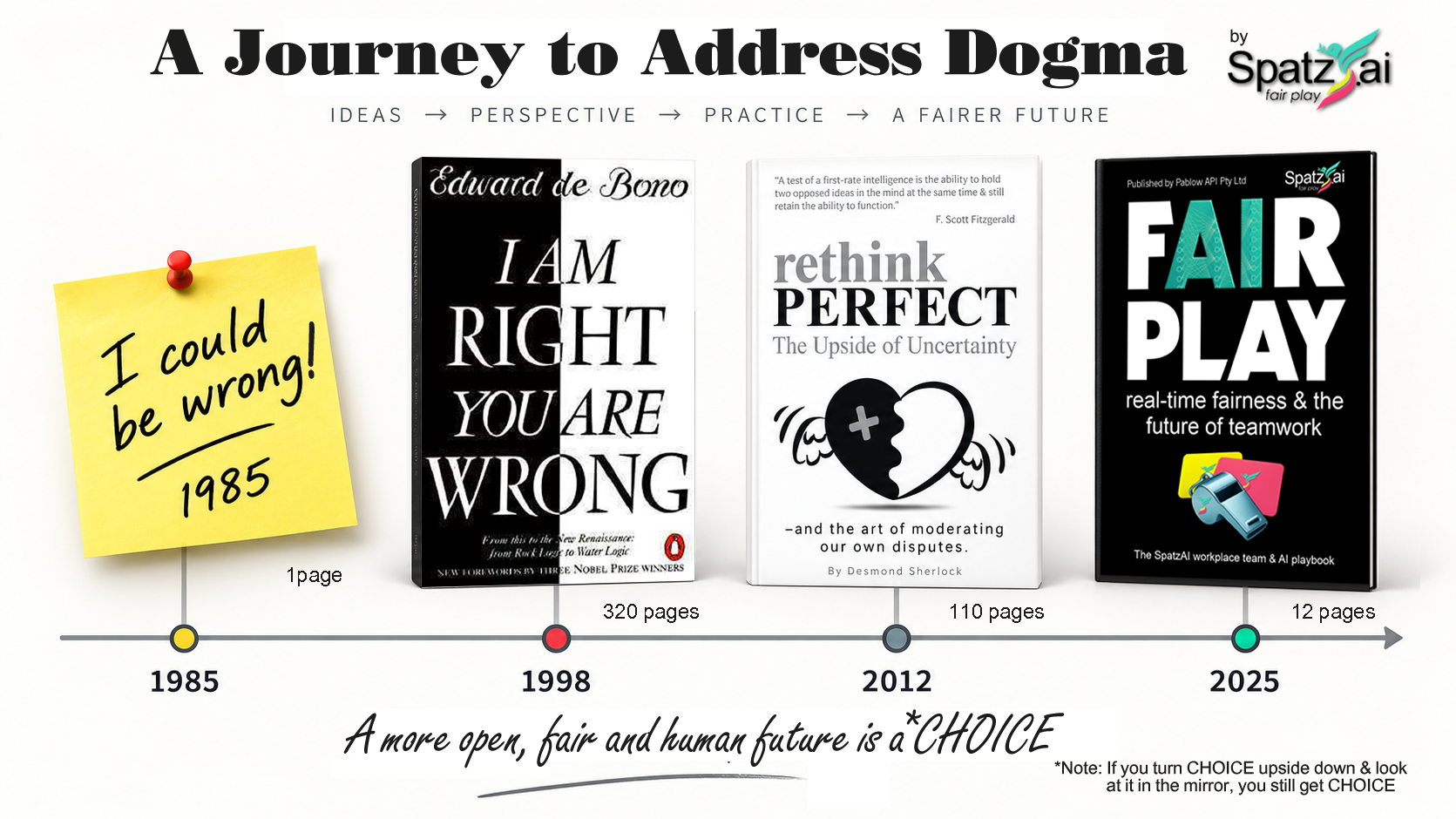
Looking at my own timeline, I can now see a thread.
1985: I could be wrong.
1998: I read de Bono’s I Am Right, You Are Wrong.
2012: self-published my book Rethink Perfect — The Upside of Uncertainty.
2025: the beginnings of the SpatzAI Team Charter and a process for putting those ideas into practice.
For me, SpatzAI is the next chapter because it attempts to turn anti-dogmatism from a philosophy into behaviour.
It isn’t enough to believe we could be wrong.
We need a fair way for another person — or perhaps another AI — to object when our certainty starts affecting how we behave toward them.
Caution. Object. Stop. Review. Revise.
Not to eliminate disagreement.
To make disagreement safer and more useful.
After roughly 40 years thinking about this, I believe it is time to execute the idea.
Humans will behave dogmatically at times, in my view.
Experts will behave dogmatically at times (more times than not).
AI can be remarkably dogmatic.
Perhaps the next step in intelligence isn’t knowing more.
Perhaps it’s getting better at saying:
“I think this is right. But I could be wrong.”


Leave a Reply