I think we may have a language problem in how teams talk about and behave around conflict, and may explain why some team members are afraid to speak up.
In everyday conversation the word conflict is used to describe many different things. It can refer to a simple difference of opinion, a heated argument between colleagues, a dispute between departments, or even a military war between nations. The scale varies enormously, yet we often use the same word for all of it.
That can create a subtle, uncertain communication problem within teams and departments.
If a disagreement is mentally framed and referred to as conflict, and as conflict usually carries strong negative associations, people may hesitate to speak up. Nobody wants to be seen as difficult or “creating conflict.” So the safest option becomes silence, avoidance, or quiet misalignment.
But disagreement itself is not the problem. In many cases it is necessary for good thinking.
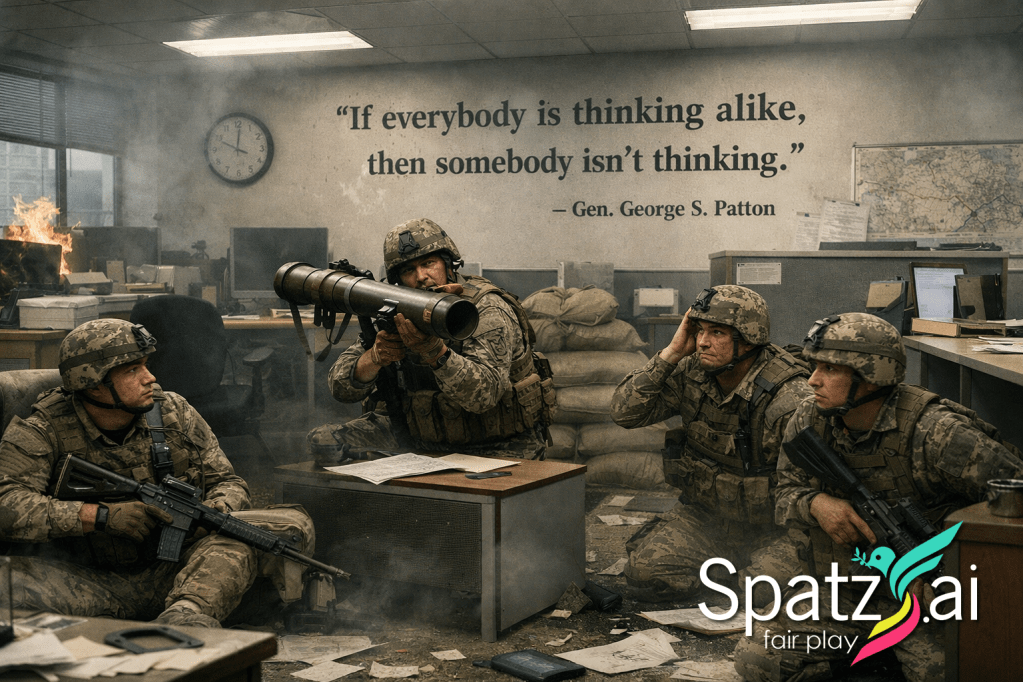
If everyone is thinking the same then somebody isn’t thinking
Gereral George S. Patton
A difference in perspective can help teams test assumptions, challenge weak ideas, and move toward better solutions. What usually causes damage is not the disagreement, but the behaviour that sometimes follows it: dismissiveness, defensiveness, personal attacks, or unresolved tension.
This is why clearer language matters.
Teams may benefit from separating the stages of interaction. For example using the SpatzAI lexicon:
1. Disagreement
Different views about an idea or decision.
No behavioral issue yet. Nothing formal is required.
2. Spat — Verbal Caution
A minor behavioral issue appears (tone, dismissal, interruption, unfair framing).
The person affected gives a verbal caution to acknowledge the behaviour and reset the interaction.
3. Micro-conflict — Formal Caution (SpatzChat app)
The behaviour is not acknowledged or continues.
The issue is recorded through the SpatzChat app as a formal caution, signalling that the interaction has moved beyond a simple spat.
4. Dispute — Formal Objection (SpatzChat app)
Positions begin to harden or the behavior is challenged rather than acknowledged.
The issue escalates to a formal objection, seeking a simple apology and correction.
5. Conflict — Formal Stop (SpatzChat app + Team and AI Review)
The disagreement and behavior can no longer be resolved between the individuals.
A formal stop is issued and the matter moves to team-assisted review.
When all of these terms are conflated into the single word conflict, the conversation becomes muddy, and people avoid the whole territory.
By differentiating and naming these levels of “conflict”, we can apply different levels of accountability for each level also.
Using distinct terms helps teams recognise what is actually happening. Providing the tools can help the team members address the issue early, keeping disagreements productive, rather than letting them devolve into something far more damaging.
 Object123
Leave a comment