Not All Conflict Is What You Think
We often use the word conflict as if it’s a standalone event. But scratch the surface and most tension comes from a more specific source: a conflict of interest, values, needs, goals, perceptions, personalities, or loyalties.
These differences don’t automatically cause damage. In fact, they’re often at the heart of diverse, high-performing teams. But when we fail to navigate them constructively, that’s when a simple disagreement tips into a spat, a dispute, or a full-blown conflict.
The real problem often isn’t the underlying difference—but the conflict in how we go about resolving it.
One person shuts down, another pushes harder. One takes offense, the other thinks they’re “just being honest.” One side gets quiet to keep the peace; the other interprets it as cold or passive-aggressive.
What’s really happening here is a conflict of resolution. And when that happens, defensiveness kicks in. Ironically, instead of defending our position, we start defending our ego—by attacking the person rather than their thinking.
It’s a self-sabotaging loop: We feel threatened → We react poorly → The other person feels threatened → They react poorly.
Suddenly, the original “conflict of interest” is forgotten, buried under layers of personal offense, blame, and misinterpretation.
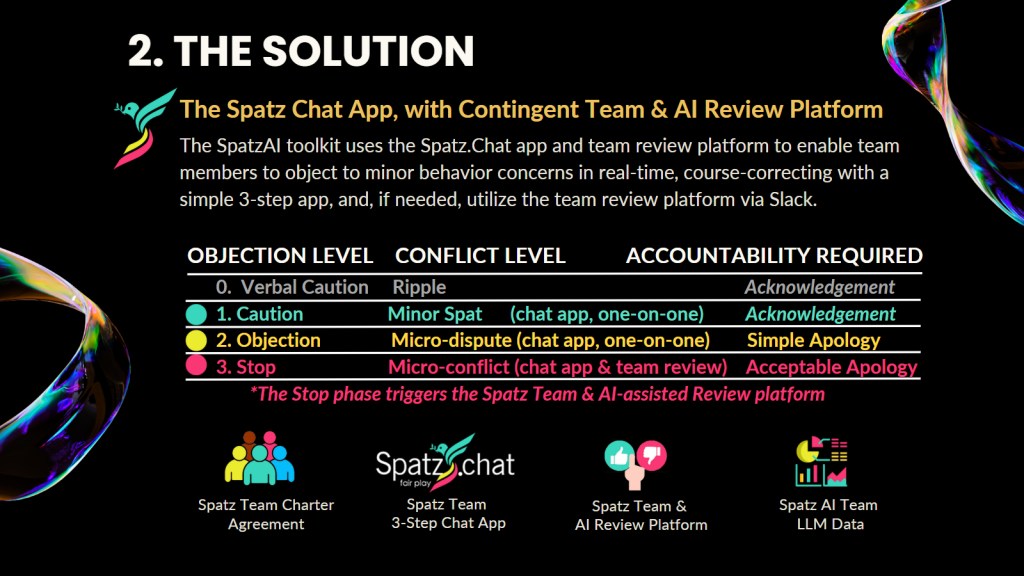
That’s why at SpatzAI, we focus on naming the type of conflict clearly and providing structured steps to resolve it before it escalates. We call this the Caution → Objection → Stop process, designed to interrupt the spiral of defensiveness and bring us back to the issue—not the person.
Conflict isn’t the enemy. Poor conflict resolution is.
When we learn to separate our ego from our argument, we unlock the real power of disagreement: growth, clarity, and stronger teams.
 Object123
Leave a comment